15 November 2026
Decision to expand naval unit's operations toward Hormuz Strait puts Korea between Scylla and Charybdis The debate at home Washington's demands Tehran's concerns What Seoul needs to do
Korea JoongAng Daily - Daily News from Korea
About
Korea's antipiracy Cheonghae Unit will patrol waters off Oman, pending parliamentary approval, but that may not satisfy Washington, Tehran or the Korean public.
[NEWS ANALYSIS]
Korea is navigating perilous waters, both literally and figuratively, as it moves its antipiracy naval unit closer to the Strait of Hormuz while remaining adamant about not being drawn into the Iran war.
Seoul has walked a tricky diplomatic and security line as it tries to appease Washington without provoking Tehran or splitting its own political bloc at home.
This balance came under new strain Thursday when an Iranian foreign ministry spokesperson used a Korean proverb on social media to warn against sending naval forces to the region.
The ball is now rolling after Seoul's Cabinet last Tuesday approved a motion to expand the Cheonghae Unit's operating area from the Gulf of Aden off Somalia to waters south of Oman. The motion reached the National Assembly the same day.
The decision comes after months of deliberation over what military role Seoul will play in Hormuz to meet U.S. demands that allies do more to stabilize the crucial strait.
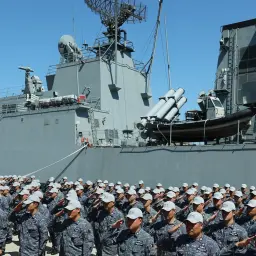
The Cheonghae Unit, built around a single destroyer, has escorted merchant ships off Somalia since 2009. Its expanded area, pending parliamentary approval, brings it nearer to a waterway Korea depends on. The new area ends off the port of Duqm, about 650 kilometers (404 miles) from the strait, and does not include the Gulf of Oman, which borders it.
Korea imported 70 percent of its crude oil from the Middle East in 2025, most of it shipped through the Strait of Hormuz. Two Korean ships are currently inside the strait.
Analysts widely see the plan as a compromise, as it answers part of Washington's call to help stabilize the strait while keeping Seoul out of the Iran war. However, experts say neither Washington nor Tehran is likely to treat this as the final word.
The Cabinet's approval of the motion to expand the scope of the Cheonghae Unit, in the name of securing the safety of the international maritime pathway and restoring freedom of passage, has been met with fierce backlash domestically, as critics say the act is tantamount to a military contribution to the U.S. war with Iran.
The unit would gain a P-8A maritime patrol aircraft, a 30-member explosive ordnance disposal team and unmanned mine-clearing equipment. Its personnel would rise from 320 to 395, and a new task would be added to its mandate, supporting the restoration of freedom of navigation on international sea lanes.
If passed by the National Assembly, the motion would extend the deployment through Dec. 31, 2027.
"Our mission entails protecting our citizens and vessels, participating in international cooperation to ensure safe and free navigation, safeguarding our energy security interests and exercising the minimum necessary right to defense or self-defense should the need arise," a senior presidential official said Thursday. "Conversely, there are clear boundaries: We will not participate in or engage in war or combat operations, nor will we place ourselves under another command structure."
The official said that by keeping to those principles, "we do not anticipate encountering dangerous situations," and that the government is giving the same explanation to the National Assembly.
That pledge has drawn questions because of one clause in the motion.
Korea's military keeps command of the unit, but tactical control shifts to an on-site commander whenever the unit joins international maritime security operations, such as those run by the Combined Maritime Forces or the European Union. The Combined Maritime Forces, a multinational naval partnership that includes the Cheonghae Unit, answers to the commander of U.S. Naval Forces Central Command.
Some observers see the clause as a possible route into operations around the strait under the label of an international mission.
Such control is only temporary and covers only specific areas, according to Defense ...