04 November 2026
Barbecue for whom? North Korea opens bulgogi restaurants in every province as meat remains a luxury. Who gets a seat The politics of meat Getting meat from elsewhere Households pay the price
Korea JoongAng Daily - Daily News from Korea
About
The nationwide rollout of upscale state-run eateries highlights North Korea's widening inequality as families and food supplies help sustain them.
Bulgogi, the marinated grilled meat that helped make Korean barbecue popular around the world, is now at the center of North Korea's latest showcase project.
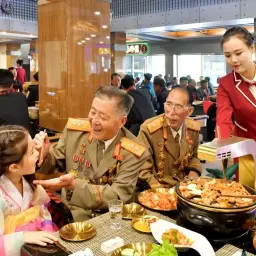
In Kanggye, a city in Jagang Province near the Chinese border, the new bulgogi "specialty" restaurant is a two-story building with a large electronic billboard on its outer wall, according to footage aired by the North's state-run Korean Central Television (KCTV).
It has a hall that seats hundreds, private rooms for families and an outdoor barbecue terrace, and serves bulgogi, along with cold noodles and soft drinks.
It is one of 13 such restaurants the North opened over about six weeks — one in Pyongyang and one in every provincial capital, the latest in Hyesan, Ryanggang Province, on Oct. 18, according to the state's mouthpiece Rodong Sinmun — in a campaign to show that living standards are improving under leader Kim Jong-un.
All follow the same design, and each stands on what state media call a "prime site," such as a riverbank, a mountainside or a port.
Bulgogi itself is not new in North Korea, and defectors say small eateries in local markets have long served it.
What is new is the size of the restaurants and the state's role in building them. State media have described the restaurants as a gift from the party, showing Kim's "devotion to the people."
"In North Korea, a 'specialty restaurant' means it's an upscale restaurant," said Jeong Eun-mee, the director of the Human Rights Research Division at the state-run Korea Institute for National Unification (KINU) in Seoul. "So these are not really restaurants for ordinary people."
Experts say the restaurants mainly serve loyalists and the newly rich, and that keeping them supplied could add to the burden on ordinary households. The United Nations estimates that more than 40 percent of North Koreans area undernourished.
"I'm not saying this to criticize North Korea," said Cho Chung-hui, a defector and head of Good Farmers, a Seoul-based nongovernmental research institute on North Korean agriculture. "But is it really for the people?"
At nearly every opening ceremony, the first guests to sit down were veterans, some disabled and state-designated "heroes."
A 2022 law on public catering gives these groups priority, according to a KINU report published by Jeong on Oct. 14.
A defector survey cited in the report shows how unevenly meat is consumed.
Among defectors who described themselves as upper class while living in North Korea in 2019, 81.8 percent ate meat at least once a week. Among lower-class respondents, the figure was 6.7 percent, and 30 percent of them ate meat only once or twice a year.
North Korean state media have not shown the restaurants' prices.
"That tells you these restaurants sell at quite a high price," Cho said.
A bowl of samgyetang, or chicken ginseng soup, costs about $7.50 at a Pyongyang restaurant, Cho said, enough to buy about 14 kilograms (31 pounds) of rice in North Korea. He expects a serving of bulgogi to cost about the same.
Meat has long been a political symbol in North Korea.
In the 1960s, founding leader Kim Il Sung promised that every citizen would one day eat rice and meat soup, wear silk clothes and live in a tile-roofed house.
Hundreds of thousands of people died in a famine in the 1990s. Today, meat is still a luxury for most North Koreans.
The new restaurants opened after the Ninth Party Congress earlier this year, which launched a new five-year economic plan under the slogan "new life, new civilization."
According to Jeong, provincial authorities were ordered early this year to finish the restaurants before Oct. 10, the founding anniversary of the ruling Workers' Party.
"It's the first year of the new five-year plan, so they needed to show results," Jeong told the Korea JoongAng Daily. "They need a showcase achievement proving that li...