19 November 2026
Andrew Lloyd Webber visits Korea for 'Phantom of the Opera' 40th anniversary
Korea JoongAng Daily - Daily News from Korea
About
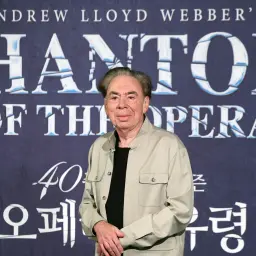
Andrew Lloyd Webber makes his first official visit to Korea as 'The Phantom of the Opera' marks 40 years and prepares for a Seoul run at Blue Square.
Korea's musical industry dates its beginning to a single show. When "The Phantom of the Opera" opened in Korean at LG Arts Center in Gangnam District, southern Seoul, in December 2001, the entire domestic musical market drew roughly 500,000 people a year. "Phantom" drew 240,000 over a seven-month run and grossed some 19.2 billion won ($14.2 million), doubling the market and bringing in the licensing, marketing and sales systems Korean producers still use. Six productions later, it has drawn more than 1.5 million audience members.
Andrew Lloyd Webber, the composer behind "Cats," "Evita" and "Jesus Christ Superstar" as well as "Phantom," never made an official visit to Korea until this week. He is in Seoul to mark the 40th anniversary of "Phantom," which opened in London's West End on Oct. 9, 1986, and the 25th anniversary of its Korean premiere.
"One of the places that I know has been incredible and wonderful for my music and my musicals has been here [in Korea], and do you know what? I'm feeling a little bit ashamed of myself for not having come here earlier," Lloyd Webber said at a press conference at the Four Seasons Hotel Seoul in Jongno District, central Seoul, on Thursday. "But work just didn't allow me, because I'm a composer and I need to be with my piano."
The 78-year-old plans to come back next year, after his new show opens, to hear what Korean composers are writing. His son, who works in the record business, has already worked here with Korean songwriters.
"I just felt that it was time for me to write something passionate and romantic," Lloyd Webber said of "Phantom," which followed a run of shows with no love story in them. "People ask me all the time what the secret of 'The Phantom of the Opera' is, and I always say I don't know, because I'd be lying if I said I know why it seems to have hit everywhere around the world."
"I don't think the message has changed at all over 40 years," he said of the musical's thematic elements. "We've got audiences which are full of young girls and young women, and that was exactly the same as we had 40 years ago. It's just a story that people seem to relate to."
This year, Lloyd Webber remixed the original 1986 cast album from its analog master tapes, and it went to No. 1 in the British charts.
On Tuesday, Lloyd Webber visited rehearsals for the upcoming Korean production, only the fourth staged in Korean. He told the cast to trust the music rather than shout key words for emphasis, according to the composer. Translations of his songs often cram in too many syllables, but the Korean lyrics fit the melodies well, Lloyd Webber said.
"What I'm drawn to is a good story," he said. "The most important thing when you're writing a musical is to get a story that is really, really strong. The shows of mine that have worked less well have been where the stories haven't really been quite right."
Lloyd Webber's next musical is about a theft. Set to open in London around next September, it follows the 1911 disappearance of the Mona Lisa from the Louvre in Paris. The thief, an Italian man, had wanted a different painting but took the one he could smuggle out.
"The whole story, which is completely true, is that the Mona Lisa was not a famous painting nor particularly rated by anybody until she was stolen," Lloyd Webber said. "She became world-famous as a painting purely because she was stolen. It made me think: What is fame, and what is the value of any piece of art?"
On productions being made with generative AI technology, Lloyd Webber drew a firm line.
"The thing to remember about AI is that it's a data processing machine," he said. "So it is only as good as what is actually programmed into it. What AI can't do is to come up with a wholly original thought."
Fifty years ago, no AI would have suggested setting T.S. Eliot's poems about cats to ...