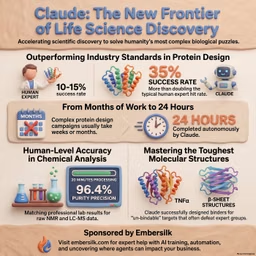
Recent research highlights how Claude AI models are significantly accelerating discovery within the life sciences by automating complex tasks in protein design and analytical chemistry. Specifically, high-level models successfully engineered protein binders against various targets with a success rate that exceeded typical human-led benchmarks. Beyond biological engineering, the AI demonstrated scientific judgment by autonomously processing raw chemical data and matching the accuracy of professional laboratories in a fraction of the time. These advancements suggest that autonomous agents can reduce the technical expertise and weeks of labor traditionally required for early-stage drug development. However, the developers emphasize that these powerful dual-use capabilities necessitate a careful balance between scientific openness and robust safety protocols. Ultimately, the findings illustrate a shift toward AI-enabled research that streamlines the interpretation of complex experimental data.
Note: This podcast was AI-generated, and sometimes AI can make mistakes. Please double-check any critical information.
Sponsored by Embersilk LLC