20 July 2026
Commercial Metal: Essential Guide for Industrial Manufacturing
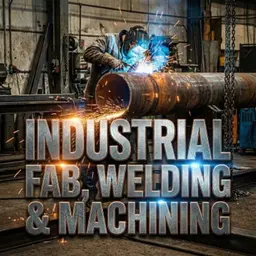
Industrial Fab, Welding & Machining
About
Commercial metals function as the foundational structure of modern civil infrastructure, heavy extraction equipment, and energy transport systems. However, even the densest structural alloys shift and deform under real-world thermodynamic stress. For example, structural steel expands approximately 6.5 millionths of its length per degree Fahrenheit, while commercial aluminum alloys expand at nearly double that rate. On this episode of Industrial Fab, Welding & Machining, the metallurgy team at LTJ Industrial Services analyzes the physical behavior of commercial metals. We examine alloy selection criteria, review non-destructive testing (NDT) standards, and explore the digital tools transforming metal fabrication.
Key Episode Highlights
Modern fabrication shops rely on digital workflows to optimize material yield and improve dimensional accuracy:
Relying on unvetted fabrication shops or failing to account for thermodynamic stress in heavy equipment leads to premature component failure, expensive rework, and unexpected site downtime. Located at 22505 US-6, Rifle, Colorado, LTJ Industrial Services combines advanced metallurgical engineering with code-certified fabrication. Our facility handles your entire production lifecycle in-house—from initial 3D CAD modeling and CNC waterjet profiling to multi-axis machining, ASME-code welding, and certified NDT quality checks. Whether you require shop-built replacement components or 24/7 mobile field repairs across the Western Slope, our team delivers code-compliant solutions built to handle real-world conditions. Stop risking your facility's output on unvetted work. Call our Rifle engineering office today at (970) 625-9353 or visit LTJIndustrial.com to upload your blueprints and request a detailed quote.
Click here to read more
Learn more about LTJ Industrial Services at www.ltjindustrial.com/
Key Episode Highlights
- Thermodynamic Behavior & Multi-Material Assemblies: When structural steel and aluminum are joined in a single assembly, their differing coefficients of thermal expansion generate severe internal stress under shifting temperatures. If fabricators do not account for these dimensional shifts using thermal expansion joints or slotted mechanical fasteners, the resulting internal strain can buckle structural framing, shear bolts, or trigger stress-corrosion cracking.Application-Specific Alloy Selection: Choosing the correct commercial metal grade requires matching physical properties to environmental conditions:
- Austenitic Stainless Steels: Standard 304 stainless steel provides general corrosion resistance, but harsh marine and chemical processing environments require 316 stainless steel, which contains molybdenum to prevent localized pitting from chlorides.Structural & Aerospace Aluminum: Workable 6061-T6 aluminum offers excellent weldability and corrosion resistance for general machining, whereas 7075-T6 aluminum utilizes zinc as its primary alloying element to deliver high strength-to-weight ratios for aerospace applications.
- Shielded Metal Arc Welding (SMAW / Stick): Ideal for outdoor field maintenance because its external flux shield resists wind disruption and surface contamination. Gas Tungsten Arc Welding (GTAW / TIG): Delivers the precise heat control needed for thin-gauge stainless steel, food-grade sanitary piping, and critical root passes.Gas Metal Arc Welding (GMAW / MIG): Maximizes deposition rates and travel speeds in high-volume shop production environments.
- Ultrasonic Testing (UT)
- Core Protocol: High-frequency sound waves evaluate internal substrate density to locate subsurface voids or inclusions.Primary Application: Thick structural steel plate, heavy forging inspection, and pressure vessel wall integrity.
- Core Protocol: X-ray or gamma radiation captures internal density images to detect weld porosity or lack of fusion.Primary Application: High-pressure cross-country pipelines, ASME Section VIII vessels, and critical aerospace joints.
- Core Protocol: Documented chemical heat numbers and mechanical pull-test results verifying foundry origin.Primary Application: Full material traceability for code-compliant oil, gas, and structural infrastructure projects.
Modern fabrication shops rely on digital workflows to optimize material yield and improve dimensional accuracy:
- Building Information Modeling (BIM) & CAD-to-CAM Integration: Translating 3D digital assemblies directly into computer-aided manufacturing (CAM) toolpaths eliminates manual layout errors and cuts design-to-fabrication cycle times.Automated Nesting Software: Advanced cutting algorithms arrange part geometries onto raw plate stock, increasing material utilization rates and cutting scrap waste.Emerging Metallurgical Alloys: High-entropy alloys (HEAs) and nanostructured metals are moving from research labs to industrial field applications, offering extreme temperature resistance and higher strength-to-weight ratios.
Relying on unvetted fabrication shops or failing to account for thermodynamic stress in heavy equipment leads to premature component failure, expensive rework, and unexpected site downtime. Located at 22505 US-6, Rifle, Colorado, LTJ Industrial Services combines advanced metallurgical engineering with code-certified fabrication. Our facility handles your entire production lifecycle in-house—from initial 3D CAD modeling and CNC waterjet profiling to multi-axis machining, ASME-code welding, and certified NDT quality checks. Whether you require shop-built replacement components or 24/7 mobile field repairs across the Western Slope, our team delivers code-compliant solutions built to handle real-world conditions. Stop risking your facility's output on unvetted work. Call our Rifle engineering office today at (970) 625-9353 or visit LTJIndustrial.com to upload your blueprints and request a detailed quote.
Click here to read more
Learn more about LTJ Industrial Services at www.ltjindustrial.com/