About
Beacon Film Society to screen doc about news broadcast
There should be at least a little bit of pit bull grit in every reporter's gut.
Amy Goodman has sacrificed her body to get the story. In 1991, she stepped into the middle of a massacre by the Indonesian military. Riot police in St. Paul, Minnesota, also roughed her up at the 2008 Republican National Convention.
At 69, she's still globetrotting. This year, she says, "I'll be in Berlin, London, Copenhagen, Brazil and Turkey." During these trips, Zazu, a Shih Tzu-Bichon Frise mix, who accompanies her human almost everywhere, including the newsroom and a protest in Manhattan, stays at home.
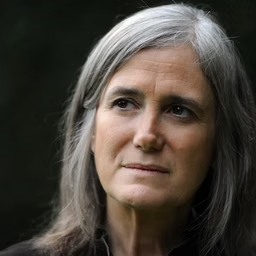
Goodman helped create Democracy Now!, an hour-long weekday news program. The Long Island native is also the subject of Steal This Story, Please!, a documentary that will be screened by the Beacon Film Society at the Howland Cultural Center on Sept. 18. The title, one of the broadcaster's mantras, reflects the desire for major media outlets to piggyback on her work and pay attention to the marginalized and forgotten.
As an independent journalist whose show airs on 1,500 radio and television stations nationwide, Goodman has shaped global events by directing tough, relentless questions at those in power, known in the trade as "comforting the afflicted and afflicting the comfortable."
Dismissed by detractors as an activist rather than a journalist, her voice is sometimes the one that is shoved aside.
"Corporate distributors refused to touch this film, so we did it ourselves, and it has played regular theatrical runs several times a day at 200 cinemas across the country," says Carl Deal, who co-directed with Tia Lessin. "It's been a slow burn, but we proved to ourselves and the gatekeepers that there is an appetite for real content beyond contrived true crime and celebrity documentaries."
Goodman developed a muckraking style at her high school newspaper, calling out the principal over disparities in spending between boys' and girls' sports. At radio station WBAI in Manhattan, her reporting helped free a death row prisoner in Louisiana. The station's coverage generated so many phone calls to the governor that his office changed the number.
In 1991, Goodman landed in East Timor, a province of Indonesia about the size of Connecticut, to investigate persecution by the military regime, a U.S. ally. Soldiers in uniform attacked unarmed gatherers at a cemetery, including Goodman and Allan Nairn at The New Yorker, killing more than 200 people in what became known as the Santa Cruz massacre.
A local journalist filmed the scene, buried the document in a fresh grave and retrieved it after nightfall. The major networks' flagship news shows "stole" the story and aired the harrowing footage, which helped spark worldwide protests; the region achieved independence in 2002.
Founded in 1996, viewer- and listener-supported Democracy Now! shuns corporate and government sponsorship. In the early days, Goodman worked with a skeleton crew, reel-to-reel tape and other antiquated technologies. Now, she operates from a gleaming studio with a team of assistants at digital workstations.
With Zazu close by, Goodman reflects on the film: "I never expected this kind of response, showing at screenings all over and winning a dozen audience favorite awards at festivals with packed crowds."
In the documentary, she explains that the dog's name refers to the "anti-Nazi youth of occupied France. They loved jazz and swing and gathered at underground nightclubs. Every time [I tell people her name], they say, 'Oh, Lion King.' I didn't know that, but I go, 'Yeah, whatever.'"
The Howland Cultural Center is located at 477 Main St. in Beacon. Tickets for the documentary, which begins at 7 p.m., are $15 at bit.ly/BFS-9-18, or $20 at the door. A Q&A with Deal and producer Karen Ranucci will follow the screening.
There should be at least a little bit of pit bull grit in every reporter's gut.
Amy Goodman has sacrificed her body to get the story. In 1991, she stepped into the middle of a massacre by the Indonesian military. Riot police in St. Paul, Minnesota, also roughed her up at the 2008 Republican National Convention.
At 69, she's still globetrotting. This year, she says, "I'll be in Berlin, London, Copenhagen, Brazil and Turkey." During these trips, Zazu, a Shih Tzu-Bichon Frise mix, who accompanies her human almost everywhere, including the newsroom and a protest in Manhattan, stays at home.
Goodman helped create Democracy Now!, an hour-long weekday news program. The Long Island native is also the subject of Steal This Story, Please!, a documentary that will be screened by the Beacon Film Society at the Howland Cultural Center on Sept. 18. The title, one of the broadcaster's mantras, reflects the desire for major media outlets to piggyback on her work and pay attention to the marginalized and forgotten.
As an independent journalist whose show airs on 1,500 radio and television stations nationwide, Goodman has shaped global events by directing tough, relentless questions at those in power, known in the trade as "comforting the afflicted and afflicting the comfortable."
Dismissed by detractors as an activist rather than a journalist, her voice is sometimes the one that is shoved aside.
"Corporate distributors refused to touch this film, so we did it ourselves, and it has played regular theatrical runs several times a day at 200 cinemas across the country," says Carl Deal, who co-directed with Tia Lessin. "It's been a slow burn, but we proved to ourselves and the gatekeepers that there is an appetite for real content beyond contrived true crime and celebrity documentaries."
Goodman developed a muckraking style at her high school newspaper, calling out the principal over disparities in spending between boys' and girls' sports. At radio station WBAI in Manhattan, her reporting helped free a death row prisoner in Louisiana. The station's coverage generated so many phone calls to the governor that his office changed the number.
In 1991, Goodman landed in East Timor, a province of Indonesia about the size of Connecticut, to investigate persecution by the military regime, a U.S. ally. Soldiers in uniform attacked unarmed gatherers at a cemetery, including Goodman and Allan Nairn at The New Yorker, killing more than 200 people in what became known as the Santa Cruz massacre.
A local journalist filmed the scene, buried the document in a fresh grave and retrieved it after nightfall. The major networks' flagship news shows "stole" the story and aired the harrowing footage, which helped spark worldwide protests; the region achieved independence in 2002.
Founded in 1996, viewer- and listener-supported Democracy Now! shuns corporate and government sponsorship. In the early days, Goodman worked with a skeleton crew, reel-to-reel tape and other antiquated technologies. Now, she operates from a gleaming studio with a team of assistants at digital workstations.
With Zazu close by, Goodman reflects on the film: "I never expected this kind of response, showing at screenings all over and winning a dozen audience favorite awards at festivals with packed crowds."
In the documentary, she explains that the dog's name refers to the "anti-Nazi youth of occupied France. They loved jazz and swing and gathered at underground nightclubs. Every time [I tell people her name], they say, 'Oh, Lion King.' I didn't know that, but I go, 'Yeah, whatever.'"
The Howland Cultural Center is located at 477 Main St. in Beacon. Tickets for the documentary, which begins at 7 p.m., are $15 at bit.ly/BFS-9-18, or $20 at the door. A Q&A with Deal and producer Karen Ranucci will follow the screening.