About
West Point plans power line corridor opposite Garrison
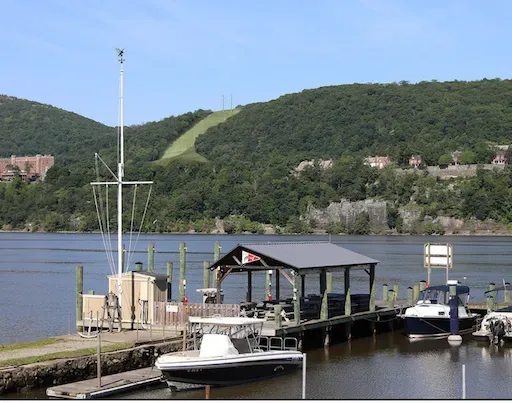
Conservation groups are raising concerns about a proposed power line that would cut a path through the forested mountain across from Garrison's Landing.
The U.S. Army wants to upgrade and construct transmission lines and substations to increase power to West Point, which will alter the viewsheds of various registered historic districts, including Harriman State Park and the Thayer Hotel and Buffalo Soldier Field on base.
Garrison's Landing is "in the direct view of this unfortunate proposal to scalp a 150-foot-wide swath through the forest, down that ridge to the Hudson River," said J. Jeffrey Anzevino, director of land use advocacy at Scenic Hudson. The landing was added to the National Register of Historic Places in 1982.
An Army report on the project maps a 2.5-mile right-of-way for two new lines that would each deliver 69 kilovolts (kV) of electricity. Of the existing 9.5 miles of lines, which run at 34.5 kV, some would be removed and others upgraded. In addition, three substations would be upgraded, a substation would be built next to one at Wilson Gate and a substation in Highland Falls would be decommissioned. A switching station would also be built. Neither West Point nor Orange & Rockland, the utility that would construct the lines and substation, responded to requests for comment.
In its report, the Army acknowledges that the project "will noticeably and substantially alter the Hudson Highlands landscape" and "diminish the integrity of setting, feeling and association" of West Point and Garrison's Landing, but says its plan is still the best option. Upgrading the existing lines to handle larger loads and projected increases to up to 138 kV without building new lines would cost an estimated $60 million more than the $113 million approved for the project. Burying the lines would also be too expensive, it said, and impact wetlands and streams.
Anzevino said conservation and preservation groups would like to know more about how the Army determined that other options, such as going underground, are not feasible. "The consensus is there's not an awful lot of detail in their rationale," said Edward Warren of the Hudson Highlands Land Trust. He cited research showing that while tunneling is more expensive, it reduces maintenance costs because the lines are protected from storm damage.
The groups also would like more information about why the upgrades are needed. Anzevino said that he was only told by West Point that it has "electrical issues" every summer.
"What is West Point doing to generate its own energy?" he said. "Renewables, battery storage?" He said the military told them the review doesn't have to consider that.
The project must undergo a National Environmental Policy Act (NEPA) review, but because West Point is federal land, it will not be subject to state review. It's not clear if the public will be invited to weigh in, Anzevino said. "I don't believe West Point is going to allow the rank and file — the residents who are going to be viewing this — to be participating," he said.
Pointing to an Army rendering that shows trees disappearing along Fort Putnam Street in Highlands Falls, he said, "I doubt the people on that street even know this is happening."
Conservation groups are raising concerns about a proposed power line that would cut a path through the forested mountain across from Garrison's Landing.
The U.S. Army wants to upgrade and construct transmission lines and substations to increase power to West Point, which will alter the viewsheds of various registered historic districts, including Harriman State Park and the Thayer Hotel and Buffalo Soldier Field on base.
Garrison's Landing is "in the direct view of this unfortunate proposal to scalp a 150-foot-wide swath through the forest, down that ridge to the Hudson River," said J. Jeffrey Anzevino, director of land use advocacy at Scenic Hudson. The landing was added to the National Register of Historic Places in 1982.
An Army report on the project maps a 2.5-mile right-of-way for two new lines that would each deliver 69 kilovolts (kV) of electricity. Of the existing 9.5 miles of lines, which run at 34.5 kV, some would be removed and others upgraded. In addition, three substations would be upgraded, a substation would be built next to one at Wilson Gate and a substation in Highland Falls would be decommissioned. A switching station would also be built. Neither West Point nor Orange & Rockland, the utility that would construct the lines and substation, responded to requests for comment.
In its report, the Army acknowledges that the project "will noticeably and substantially alter the Hudson Highlands landscape" and "diminish the integrity of setting, feeling and association" of West Point and Garrison's Landing, but says its plan is still the best option. Upgrading the existing lines to handle larger loads and projected increases to up to 138 kV without building new lines would cost an estimated $60 million more than the $113 million approved for the project. Burying the lines would also be too expensive, it said, and impact wetlands and streams.
Anzevino said conservation and preservation groups would like to know more about how the Army determined that other options, such as going underground, are not feasible. "The consensus is there's not an awful lot of detail in their rationale," said Edward Warren of the Hudson Highlands Land Trust. He cited research showing that while tunneling is more expensive, it reduces maintenance costs because the lines are protected from storm damage.
The groups also would like more information about why the upgrades are needed. Anzevino said that he was only told by West Point that it has "electrical issues" every summer.
"What is West Point doing to generate its own energy?" he said. "Renewables, battery storage?" He said the military told them the review doesn't have to consider that.
The project must undergo a National Environmental Policy Act (NEPA) review, but because West Point is federal land, it will not be subject to state review. It's not clear if the public will be invited to weigh in, Anzevino said. "I don't believe West Point is going to allow the rank and file — the residents who are going to be viewing this — to be participating," he said.
Pointing to an Army rendering that shows trees disappearing along Fort Putnam Street in Highlands Falls, he said, "I doubt the people on that street even know this is happening."