11 September 2026
6 Takeaways: Dutchess Transportation Cars aren't going anywhere Many obstacles for two wheels The roads need help Money is hard to find Public transit an option Questions remain
Highlands Current Audio Stories
About
Forecast documents trends, needs, funding
The Dutchess County Transportation Council adopted a 25-year forecast last month that sets priorities for cars, public transit, walking and bike infrastructure. The plan is updated every five years. To solicit ideas, the council held public meetings and pop-up events, including at the Beacon Farmers' Market. Here are six takeaways:
Dutchess County has 2,521 miles of public roads. The council estimates that 81 percent of trips, and 77 percent of commutes, are made with personal vehicles — rates that have remained largely unchanged since 1980. The county's population, at about 300,000 people, has also remained steady, but the number of passenger vehicles grew by 4 percent over the 15 years before 2025. (There are about 7,500 vehicles registered in the county.)
Traveling for family reasons and personal business account for 36 percent of trips, followed by 28 percent for social and recreational activities. Commuting makes up 21 percent of trips. Those trends are expected to hold, although the report predicts slightly less commuting because of remote and hybrid work, and fewer shopping trips because of home delivery. The number of people working from home increased from 8 percent in 2019 to 14 percent in 2023.
Electric vehicles cut pollution, but without a robust charging network, many people hesitate to purchase them. E-bikes make cycling more accessible and let people travel farther, but the devices raise safety concerns because they can reach 20 mph or higher; riders do not need a license, and not everyone wears a helmet.
"Unless our development patterns change substantially, transit, walking and bicycling are unlikely to be feasible for many trips, especially outside of our cities, villages and town centers," the council says.
The council notes there are challenges to replacing car trips with pedal power. The state Department of Transportation has designated an on-road bike route on part of the Empire State Trail in northern Dutchess, along with segments of Routes 9, 9D, 22, 199 and 308. However, the routes run on shared travel lanes and/or shoulders and are intended for experienced adult cyclists. No dedicated lanes exist except along short segments of Route 9. This creates what the council report calls "a major impediment to people feeling comfortable bicycling for everyday travel."
In 2025, the council concluded that a rail trail between Beacon and Hopewell Junction utilizing a 13-mile corridor abandoned by the Metropolitan Transportation Authority could be built. The project just lacks a sponsor and funding. The City of Beacon intends to construct the 3.3-mile segment from its waterfront to the Town of Fishkill and has hired an engineering firm. On Tuesday (Sept. 8), Mayor Lee Kyriacou named 11 members to a committee that will provide input on trail projects, including, first and foremost, the Beacon Rail Trail.
The Department of Transportation says that, of the county's 655 miles of roads that qualify for federal aid, 321 miles, or about half, are in "good" condition or better. (That's from 2023, the most recent survey available.) Fourteen percent were rated "poor." About 30 miles of interstate and "principal arterials" in the county, or 12 percent of the total, were in poor condition.
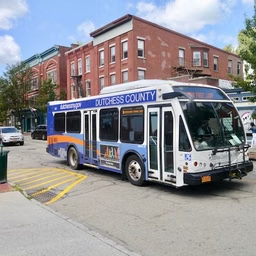
While Dutchess anticipates receiving more than $1.5 billion in highway funding over the next 25 years, that will not be enough to maintain infrastructure. The county also expects $1 billion in transit funding. It estimates that funding and expenses will break even for rail service but produce a deficit for buses.
The county will have to address the shortages by reducing costs (such as deferring maintenance), increasing funding or using "innovative" financing methods such as public/private partnerships, tolls and other user fees and local sales taxes.
The report also highlights eight "illustrative" projects that lack funding. The Beacon-to-Hopewell trail is one, along with conversion to a zero-emis...
The Dutchess County Transportation Council adopted a 25-year forecast last month that sets priorities for cars, public transit, walking and bike infrastructure. The plan is updated every five years. To solicit ideas, the council held public meetings and pop-up events, including at the Beacon Farmers' Market. Here are six takeaways:
Dutchess County has 2,521 miles of public roads. The council estimates that 81 percent of trips, and 77 percent of commutes, are made with personal vehicles — rates that have remained largely unchanged since 1980. The county's population, at about 300,000 people, has also remained steady, but the number of passenger vehicles grew by 4 percent over the 15 years before 2025. (There are about 7,500 vehicles registered in the county.)
Traveling for family reasons and personal business account for 36 percent of trips, followed by 28 percent for social and recreational activities. Commuting makes up 21 percent of trips. Those trends are expected to hold, although the report predicts slightly less commuting because of remote and hybrid work, and fewer shopping trips because of home delivery. The number of people working from home increased from 8 percent in 2019 to 14 percent in 2023.
Electric vehicles cut pollution, but without a robust charging network, many people hesitate to purchase them. E-bikes make cycling more accessible and let people travel farther, but the devices raise safety concerns because they can reach 20 mph or higher; riders do not need a license, and not everyone wears a helmet.
"Unless our development patterns change substantially, transit, walking and bicycling are unlikely to be feasible for many trips, especially outside of our cities, villages and town centers," the council says.
The council notes there are challenges to replacing car trips with pedal power. The state Department of Transportation has designated an on-road bike route on part of the Empire State Trail in northern Dutchess, along with segments of Routes 9, 9D, 22, 199 and 308. However, the routes run on shared travel lanes and/or shoulders and are intended for experienced adult cyclists. No dedicated lanes exist except along short segments of Route 9. This creates what the council report calls "a major impediment to people feeling comfortable bicycling for everyday travel."
In 2025, the council concluded that a rail trail between Beacon and Hopewell Junction utilizing a 13-mile corridor abandoned by the Metropolitan Transportation Authority could be built. The project just lacks a sponsor and funding. The City of Beacon intends to construct the 3.3-mile segment from its waterfront to the Town of Fishkill and has hired an engineering firm. On Tuesday (Sept. 8), Mayor Lee Kyriacou named 11 members to a committee that will provide input on trail projects, including, first and foremost, the Beacon Rail Trail.
The Department of Transportation says that, of the county's 655 miles of roads that qualify for federal aid, 321 miles, or about half, are in "good" condition or better. (That's from 2023, the most recent survey available.) Fourteen percent were rated "poor." About 30 miles of interstate and "principal arterials" in the county, or 12 percent of the total, were in poor condition.
While Dutchess anticipates receiving more than $1.5 billion in highway funding over the next 25 years, that will not be enough to maintain infrastructure. The county also expects $1 billion in transit funding. It estimates that funding and expenses will break even for rail service but produce a deficit for buses.
The county will have to address the shortages by reducing costs (such as deferring maintenance), increasing funding or using "innovative" financing methods such as public/private partnerships, tolls and other user fees and local sales taxes.
The report also highlights eight "illustrative" projects that lack funding. The Beacon-to-Hopewell trail is one, along with conversion to a zero-emis...