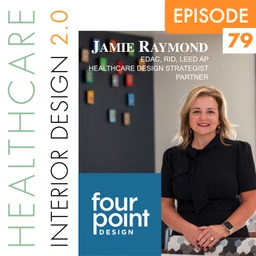
Episode 79, Jamie Raymond, EDAC, RID, LEED AP, WBE, Healthcare Design Strategist, Partner at Four Point Design
Healthcare Interior Design 2.0
"I quickly fell in love with the complexity of the spaces, the ability to support people in their healing journey and support the caregivers who dedicate their lives to caring for others." –Jamie Raymond on The Healthcare Interior Design 2.0 podcast
Jamie Raymond didn't set out to become a healthcare interior designer. An unexpected change during a summer internship led her to BSA LifeStructures — and on her very first day, to a cancer center. Nearly three decades later, healthcare design has become both her passion and her calling.
On today's episode of Healthcare Interior Design 2.0, Cheryl speaks with Jamie Raymond, Healthcare Design Strategist and partner at Four Point Design, about why interior designers need a meaningful seat at the table early in the design process, what she has learned from a nearly 20-year relationship with Eskenazi Health, and why listening closely to caregivers can completely change the direction of a healthcare environment.
Jamie shares some wonderful examples: mountain imagery that caregivers immediately associated with an EKG graph; butterflies that carried an unexpected meaning in a pediatric hospital; and staff lounges with beautiful daylight that caregivers didn't use because they were simply too far from their patients.
The conversation also looks ahead at the forces reshaping healthcare interiors today — from post-COVID material durability and workforce pressures to modular construction, rapidly changing technology, and the continuing need to create spaces of calm, respite, dignity, and human connection.
KEY TAKEAWAYSIn this episode, Cheryl and Jamie discuss:
How an unexpected summer internship led Jamie into healthcare design — and ultimately changed the direction of her career
Why healthcare became far more than a specialty for Jamie and eventually became her calling
The thinking behind Four Point Design's intentionally small, interiors-only practice
Why interior designers need a meaningful seat at the table early in the planning and design process
The difference between deeply understanding a project and becoming what Jamie calls a "finish picker"
How an experienced interiors team can become an extension of an architecture firm and healthcare organization
Jamie's nearly 20-year relationship with Eskenazi Health and what long-term continuity can teach designers
What it means to walk through a hospital years later and see how design decisions have actually aged
The commitment Eskenazi Health has made to maintaining the integrity of its original design, materials, artwork, and environment
Why designers cannot assume they understand what caregivers need
How caregiver visioning sessions uncover associations and meanings a design team could never predict
The mountain imagery that caregivers immediately associated with EKG graphs
The unexpected meaning of butterflies in one pediatric healthcare environment
How furniture fairs allow caregivers to test, score, move, and interact with furniture before decisions are made
What existing-facility tours reveal about how people really use healthcare spaces
Why a beautiful staff lounge isn't useful if caregivers don't have enough time to reach it
New approaches to caregiver respite spaces, including smaller rooms close to patient care areas
How COVID permanently changed expectations around cleaning, disinfection, upholstery, furniture, flooring, and other healthcare materials
How construction workforce challenges are influencing the way interior environments are detailed and built
The growing role of modular, prefabricated, and off-site manufactured interior components
Jamie's hope that healthcare technology eventually becomes almost invisible within the built environment
Why healthcare spaces must continue to provide calm, safety, respite, and connection even as the industry continues to change
Four Point Design
Visit Four Point Design
Eskenazi Health / Sidney & Lois Eskenazi Hospital
Explore the Eskenazi Health Downtown Campus
Learn more about Sidney & Lois Eskenazi and their $40 million gift
"Engaging Caregivers in the Design Process"
By Jamie Raymond, RID, EDAC, LEED AP and Victoria Numbers, RID, MSIA, CHID
Healthcare Construction + Operations News
Read the article
BSA LifeStructures
Visit BSA LifeStructures
HKS
Explore HKS Healthcare
MEMORABLE GUEST QUOTES
"I quickly fell in love with the complexity of the spaces, the ability to support people in their healing journey and support the caregivers who dedicate their lives to caring for others."
"I call that becoming a finish picker, where you're really working at a very surface layer to get a job done and not really digging in and understanding the why and the details of a project."
"As your interior design partner, we're singularly focused on the patient, family, and staff experience."
"You feel like a colleague and not a consultant."
"We cannot possibly understand the perspective of being a caregiver. We have to ask those questions and give them time to absorb and imagine their ideal state."
"If they don't have time to leave their unit, then we have to figure out what we are going to do to make where they work appropriate for them and supportive to them."
"What I'm hoping is we get to the point where technology just becomes seamless."
"My hope is that with these buildings, we continue to provide respite, calm, safety for patients and staff."
CONNECT WITH JAMIEJamie Raymond, RID, EDAC, LEED AP
Partner, Four Point Design
Indianapolis, Indiana
Four Point Design: https://www.fourpointdp.com/
Connect with Jamie on LinkedIn:
https://www.linkedin.com/in/jamie-raymond-edac-rid-leed-ap-3278827/
Email: jamie@fourpointdp.com
OUR SPONSOR
This podcast is sponsored by Porcelanosa. Download the latest issue of Lifestyle magazine to see award winning architecture, interior design and wellness projects worldwide. Just go to Porcelanosa.com and search Lifestyle magazine to access the complete library…. and be inspired.
OUR INDUSTRY PARTNERS
The world is changing quickly. The Center for Health Design is committed to providing the healthcare design and senior living design industries with the latest research, best practices and innovations. The Center can help you solve today's biggest healthcare challenges and make a difference in care, safety, medical outcomes, and the bottom line. Find out more at healthdesign.org.
Additional support for this podcast comes from our industry partners:
The American Academy of Healthcare Interior Designers
The Nursing Institute for Healthcare Design
Learn more about how to become a Certified Healthcare Interior Designer® by visiting the American Academy of Healthcare Interior Designers at: https://aahid.org/.
Connect to a community interested in supporting clinician involvement in design and construction of the built environment by visiting The Nursing Institute for Healthcare Design at https://www.nursingihd.com/
------------
FEATURED PRODUCTPorcelanosa are at the forefront of sustainable manufacturing – clients not only expect this of their suppliers but are increasingly asking to see the receipts.
Let's unpack this, did you know that hundreds of preeminent members of The American Institute of Architects – The AIA – have signed the AIA Materials Pledge? The Pledge is aligned with the Mindful Materials Common Materials Framework – the CMF. This is just one, very impressive example of how the movement to support decision making for building product selection has reached new highs. We can see these explained as 5 pillars of sustainability:
(The first) - Human Health: Focusing on avoiding hazardous substances and promoting well-being.
(Then) - Social Health & Equity: Addressing human rights and fair labor practices throughout the supply chain.
(The third) is Ecosystem Health: Supporting the regeneration of natural resources and habitats.
(This is followed by) Climate Health: Reducing and sequestering carbon emissions.
(And the fifth pillar) is The Circular Economy: Promoting a zero-waste future through design for resilience, adaptability, and reuse.
I mentioned the receipts -How do we track the progress of these principles and values? Without measurement, there's no clear path to improvement or accountability.
The Mindful Materials CMF maps a framework of over 650 sustainability factors across those five key areas.
A cornerstone of material health transparency is an Environmental Product Declaration EPD report. The best are independently verified for accuracy by third party certification bodies – a company cannot mark their own report cards. EPDs are highly technical documents containing scientific information on the embodied carbon used to manufacture products. I have just read and included here an EPD for a Porcelanosa Tile – there are upwards of 1000 data inputs to quantify its climate impact.
Porcelanosa offer the confidence and certainty of knowing that every tile, every slab of XTONE porcelain or KRION solid surface has a Product Specific EPD – when architects and designers work with these materials they are making a robust decision to meet their sustainable design goals.
To learn more about how Porcelanosa help their customers design for resiliency, here is a link to their comprehensive Corporate Social Responsibility Report: https://www.porcelanosa.com/en/corporate-social-responsibility/.