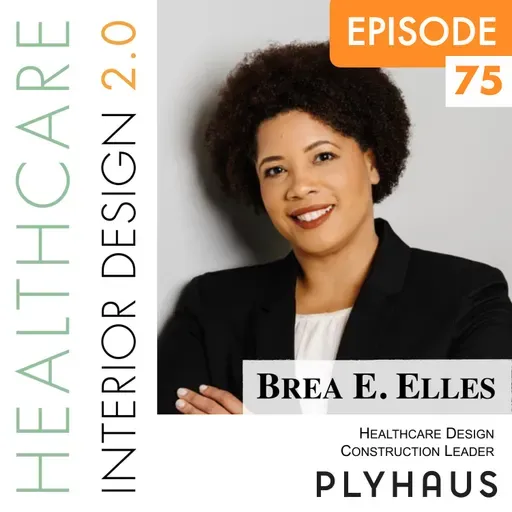
Episode 75, Brea E. Elles, Healthcare Design & Construction Leader, Owner of Plyhaus
Healthcare Interior Design 2.0
In today's episode, Cheryl sits down virtually with Brea E. Elles, Healthcare Design & Construction Leader. Together they pull back the curtain on what owner-side leadership really looks like when capital planning meets real-world constraints: staffing shortages, reimbursement uncertainty, supply chain, and the relentless need to keep care moving.
You'll hear her practical frameworks for designing "for flow," why standardization can reduce cognitive stress for clinicians, and how teams can protect performance when budgets tighten. And if you love the details, Brea goes delightfully nerdy on the behind-the-scenes decisions that make healthcare millwork and furniture succeed (or fail) over time — from seams and water intrusion to integrated sinks, chemical resistance, and specs written for performance.
In this episode, we cover:
What it actually means to sit at the intersection of finance + operations + design + construction—and why alignment is the job.
The teaching mindset that carries into project leadership: if you can't explain why, you don't fully understand the decision.
Lean healthcare design in one phrase: design for flow—patient flow, staff flow, equipment flow, information flow.
A blunt truth: "Every unnecessary step is a cost"… and inefficient adjacencies compound into burnout.
How policy/funding uncertainty (including the "Big Beautiful Bill") shows up as more disciplined revenue assumptions, phasing, and scope restraint.
Why patient experience isn't just the lobby: staff experience drives patient experience through workflow and physical demands.
The post-COVID shift that won't go away: conversion speed + flexibility as core performance.
"Standardization is resilience": how standards reduce cognitive load and keep clinicians focused on care.
Rural vs urban: durability, simplified infrastructure, and designing for a community asset that carries generational weight.
Plyhouse and the millwork "nerd-out": infection prevention through seam minimization, integral sinks, edge protection, chemical resistance—and specs written for performance.
Memorable quotes from Brea
"I sit at the intersection of finance, operations, design, and construction."
"I align people who think differently."
"If you can't explain why a decision matters, you don't fully understand it."
"Every unnecessary step is a cost. Every inefficient adjacency becomes burnout over time."
"You're designing for the person that's moving through the space, not the person photographing it."
"Standardization is resilience."
"In urban systems, you manage complexity. In rural systems, you're managing vulnerability."
"I saw a disconnect between specification and reality."
"Specs should be designed for performance, not just by material type."
"When you think about surfaces, you want to minimize your seams."
"In order to have patient experience… it's also staff experience."
"Design for flow… not just patient flow, but staff flow, equipment flow, information flow."
Links & ways to connect
Email: brea@plyhaus.com
Plyhouse: https://plyhaus.com
Brea on LinkedIn:https://www.linkedin.com/in/brea-e-elles-58776aa1/
If you liked this episode…
Please share it with a nurse, designer, architect, engineer, or administrator who cares about building healthcare environments that feel more human—and more kind.
Our Industry Partners
The world is changing quickly. The Center for Health Design is committed to providing the healthcare design and senior living design industries with the latest research, best practices and innovations. The Center can help you solve today's biggest healthcare challenges and make a difference in care, safety, medical outcomes, and the bottom line. Find out more at healthdesign.org.
Additional support for this podcast comes from our industry partners:
The American Academy of Healthcare Interior Designers
The Nursing Institute for Healthcare Design
Learn more about how to become a Certified Healthcare Interior Designer® by visiting the American Academy of Healthcare Interior Designers at: https://aahid.org/.
Connect to a community interested in supporting clinician involvement in design and construction of the built environment by visiting The Nursing Institute for Healthcare Design at https://www.nursingihd.com/
------------
The world is changing quickly. The Center for Health Design is committed to providing the healthcare design and senior living design industries with the latest research, best practices and innovations. The Center can help you solve today's biggest healthcare challenges and make a difference in care, safety, medical outcomes, and the bottom line. Find out more at healthdesign.org
FEATURED PRODUCTPorcelanosa are at the forefront of sustainable manufacturing – clients not only expect this of their suppliers but are increasingly asking to see the receipts.
Let's unpack this, did you know that hundreds of preeminent members of The American Institute of Architects – The AIA – have signed the AIA Materials Pledge? The Pledge is aligned with the Mindful Materials Common Materials Framework – the CMF. This is just one, very impressive example of how the movement to support decision making for building product selection has reached new highs. We can see these explained as 5 pillars of sustainability:
(The first) - Human Health: Focusing on avoiding hazardous substances and promoting well-being.
(Then) - Social Health & Equity: Addressing human rights and fair labor practices throughout the supply chain.
(The third) is Ecosystem Health: Supporting the regeneration of natural resources and habitats.
(This is followed by) Climate Health: Reducing and sequestering carbon emissions.
(And the fifth pillar) is The Circular Economy: Promoting a zero-waste future through design for resilience, adaptability, and reuse.
I mentioned the receipts -How do we track the progress of these principles and values? Without measurement, there's no clear path to improvement or accountability.
The Mindful Materials CMF maps a framework of over 650 sustainability factors across those five key areas.
A cornerstone of material health transparency is an Environmental Product Declaration EPD report. The best are independently verified for accuracy by third party certification bodies – a company cannot mark their own report cards. EPDs are highly technical documents containing scientific information on the embodied carbon used to manufacture products. I have just read and included here an EPD for a Porcelanosa Tile – there are upwards of 1000 data inputs to quantify its climate impact.
Porcelanosa offer the confidence and certainty of knowing that every tile, every slab of XTONE porcelain or KRION solid surface has a Product Specific EPD – when architects and designers work with these materials they are making a robust decision to meet their sustainable design goals.
To learn more about how Porcelanosa help their customers design for resiliency, here is a link to their comprehensive Corporate Social Responsibility Report: https://www.porcelanosa.com/en/corporate-social-responsibility/.