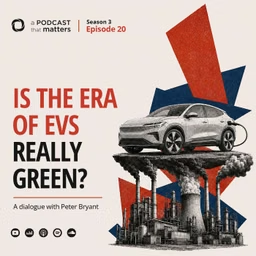
The world produces around 25 million metric tons of copper a year and needs to almost double that within a decade to meet the growing demand of various industries, including the one producing electric vehicles (EVs). It will not. By 2035, the shortfall could reach 12 million tons annually—enough copper for 150 million electric cars that will simply never be built. In this episode of the DevelopmentAid Dialogues podcast, host Hisham Allam speaks with Peter Bryant, Board Chair of Clareo, about the minerals behind the electric vehicle boom—and why the industry that supplies them cannot move at the speed the climate targets demand. Co-Founder and Board Chair of the Development Partner Institute and head of the Washington-based Key Minerals Forum, Bryant advises both the companies doing the extracting and the legislators setting the deadlines.
He begins with what he calls materials intensity.
“All the studies again try and quantify emissions from mines, but they don’t quantify water,” he said.
The omission is not minor. A report from the International Council on Mining and Metals (ICMM), published a week before the recording, found that 67% of the world’s mines sit in water-stressed areas. Whose land they sit on is a second blind spot.
“Eighty percent of minerals that we require globally either sit directly on or adjacent to indigenous lands,” argues Bryant, citing the First Nations Major Projects Coalition in Canada.
He calls the gap a “minerals famine,” and he does not believe the market has priced it in.
“We will be 10 to 12 million tons short per annum of copper by 2035,” he warned. The same shortfall, he noted, would strand roughly 1,800 gigawatts of solar.
So, does he accept that an EV repays its manufacturing carbon debt within 40,000 km (25,000 miles)?
“I think it’s a utopian calculation,” he said.
His alternative is not to abandon electrification but to widen it.
“For the materials that we put into one EV, I can build 6 plug-ins and 90 hybrids,” he said, citing Toyota.
Those 90 hybrids, used to substitute cars aged over 10 years, cut emissions 26% more than the single EV would, he explained.
Why not recycle rather than mine? Copper already runs near 30%, and Bryant does not expect that to move much.
“Just to hope, throw out a number of 30% recycling, therefore we don’t need to do the hard work, creates a blind comfort,” he said.
On “who” should process the world’s minerals, he was blunter still.
“I don’t think it’s acceptable to tell a country that has a resource, just ship it to us and you lose all that downstream value,” he stressed.
Asked what an honest verdict ten years from now would sound like, Bryant set three tests: most of the world’s ageing vehicle fleet replaced, most new mineral demand met through innovation rather than new mines, and indigenous communities owning the resource and selling equity back to the operators.
Listen to the full episode with Peter Bryant on DevelopmentAid Dialogues. Stay informed. Stay engaged.
The podcast is sponsored by DevelopmentAid. Procurement notices, funding and grants to opportunities, lists of potential partners, insights into market trends, databases of development professionals, webinars, latest news, and much more. Stay informed and connected.
Subscribe and Stay Connected