04 January 2026
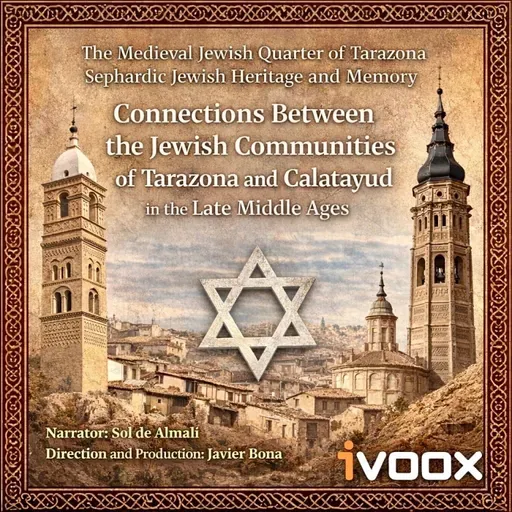
Connections Between the Jewish Communities of Tarazona and Calatayud in the Late Middle Ages
Desde Calatayud Voces de Sefarad
About
Connections Between the Jewish Communities of Tarazona and Calatayud in the Late Middle Ages
Introduction: More Than Neighbors
When we picture life in the Middle Ages, we often imagine walled cities and isolated communities, each living out its own distinct story. But this picture is frequently incomplete. History is rarely so tidy. A powerful counter-example comes from medieval Aragon, Spain, where the Jewish communities of two rival cities, Tarazona and Calatayud, were locked in a relationship of such deep interdependence that their fates were one and the same.
This is not just a story of two neighboring towns. It is a story that challenges our assumptions, revealing a surprisingly interconnected reality of rivalry, reliance, and shared destiny that historians are now uncovering. It's a look beyond the city walls into the hidden alliance that defined medieval Spanish Jewry.
--------------------------------------------------------------------------------
1. They Weren't Isolated Islands, But a Strategic Power Duo
The core truth of the relationship between Tarazona and Calatayud is counter-intuitive: they functioned less like competitors and more like two divisions of a single enterprise.
Calatayud was the regional "metropolis." As the second-largest city in the kingdom after Zaragoza, its Jewish community (or aljama) was a demographic and political heavyweight. Tax records from the turn of the 15th century show its Jewish quarter was more than five times the size of Tarazona's. It handled high-level politics for the entire western frontier of Aragon, and historical records describe its community as one of the most:
"...numerous, dynamic, and prosperous"
...in the entire kingdom. The most undeniable proof of its dominance comes from the Royal Curia of 1383. When King Pedro IV summoned representatives from every Jewish community, only two men spoke for all of Aragon: one from Zaragoza, and Içach de Quatorze from Calatayud, who single-handedly represented the interests of the entire region, including Tarazona. This wasn't just a bureaucratic detail; it was a clear demonstration of where real power lay.
Tarazona, though much smaller, was the strategically vital "dry port." Situated on the sensitive border with the Kingdom of Castile, its Jewish community developed a highly specialized profile. It was a crucial node in the Soria-Tarazona-Calatayud trade axis, where Castilian Jewish merchants like Simuel Abenate and Yuge Benacan funneled wool and textiles into Aragon. Tarazona's Jews were also experts in medicine and the complex administration of church and noble estates.
This functional specialization meant they weren't just neighbors; they were an integrated system. Calatayud provided the political muscle and demographic scale, while Tarazona offered specialized skills and a crucial gateway to the neighboring kingdom.
--------------------------------------------------------------------------------
2. Power Was a Family Business That Spanned the Kingdom
The true link between the cities was forged not by royal decree but by blood. Powerful, cross-generational family dynasties operated across city walls like modern multi-site corporations, and their changing stories reveal the shifting nature of power over time.
The Political Powerhouse: The Portella Family
The story of the Portellas in the 13th century is emblematic of the era of peak Jewish influence. Muça de Portella originated in Tarazona and, through sheer financial genius, rose to become a top administrator for King Pedro III. His family’s network managed royal finances, border fortifications, and vast credit lines that connected Tarazona with Calatayud and beyond, effectively acting as a decentralized royal bank. Their power was direct, tied to the Crown and the very infrastructure of the kingdom.
The Intellectual Network: The Alconstantini Family
By the late 14th century, the nature of influence had changed. The Alconstantini family of Calatayud represents a later period where survival and professional expertise were paramount. After the violent anti-Jewish riots of 1391, a member of the clan, Salomón Alconstantini, served as a high-status physician in Tarazona, demonstrating the transfer of essential human capital in a time of crisis. Other family members became respected rabbis in other cities. For these elite clans, the entire region was a single social stage, and their networks ensured that power, wealth, and expertise flowed freely between the city walls, adapting to the needs of a world growing more dangerous.
--------------------------------------------------------------------------------
3. A Shared War Forged a Traumatic, Unbreakable Bond
The brutal "War of the Two Pedros" (1356-1369) between the kingdoms of Aragon and Castile was a catastrophe that, paradoxically, strengthened the ties between the two communities forever.
Located on the front lines, Tarazona and Calatayud suffered devastating sieges. Their Jewish quarters (juderías), often located near the defensive walls, were the first to be destroyed. This triggered a massive refugee crisis, forcing Jewish families from both cities to flee inland to safer locations like Huesca. King Pedro IV of Aragon had to issue special safe-conduct passes to manage the exodus.
The war also revealed deep-seated suspicions. Castilian Jews residing in Tarazona were treated as a potential "Quinta Columna" (Fifth Column) by Aragonese authorities, who viewed them as enemies and forced many to move further inland. This layer of internal mistrust makes the bond forged through shared suffering even more profound.
After the war, royal permits granted to rebuild Tarazona’s main synagogue paint a poignant picture of the devastation. The official decree described the building as having been:
"...demolished and destroyed by the occupation of said city."
This shared trauma—the experience of destruction, displacement, and the collective effort of rebuilding—transformed a relationship of strategic convenience into a deeply felt alliance of survival.
--------------------------------------------------------------------------------
4. The Same Class Struggle Erupted in Both Cities
Life within the aljamas was not always harmonious. A deep social fault line ran through both communities, pitting a wealthy oligarchy of financiers against artisans and small merchants. These were not vague labels, but formal, recognized social strata—the "Mano Mayor" (Upper Hand), "Mediana" (Middle Hand), and "Menor" (Lower Hand)—that determined political rights and tax obligations. The power of the "Mano Mayor" came from its role as creditor to the surrounding Christian rural population, a source of both wealth and tension.
The first domino fell in Calatayud. In 1342, the "Mano Menor" organized a successful rebellion against ordinances created by the elite, forcing the Crown to recognize their right to political representation.
This event in Calatayud served as a blueprint. This was more than just imitation; it was a direct import of political ideas from the larger, more sophisticated metropolis. Decades later, between 1409 and 1420, Tarazona implemented its own formal ordinances that directly mirrored the reforms won in Calatayud. These new laws ensured that council positions were shared equitably among the three social classes and explicitly prohibited nepotism, proving that social and political ideas traveled just as easily as people and goods.
--------------------------------------------------------------------------------
5. A Woman's Brave Stand Reveals a World in Collapse
Sometimes, the grand narrative of history is best understood through the story of a single person. The microhistory of a woman named Sol de Almalí provides a personal and powerful lens into the final, tragic phase of this interconnected world.
The scene is the aftermath of the horrific anti-Jewish riots of 1391. Sol's husband, Acah Galup, converted to Christianity to save his life, adopting the name Juan Sánchez de Calatayud—a choice signaling his family's deep connections to the city.
Sol refused. In an incredible act of resistance, she legally divorced her now-Christian ex-husband and moved to Tarazona, where the local bishop was offering a measure of protection to the few remaining Jews. But she didn't just hide. From Tarazona, Sol demonstrated remarkable agency. She used Christian notaries to manage her wealth and empower her family members in other cities, skillfully navigating the legal systems between communities to protect her assets and her faith.
Her story is a poignant symbol of the era's end. The inter-city networks that once enabled prosperity were now being used for desperate acts of survival. The rising tide of mass conversions and the future establishment of the Inquisition would soon sever these ancient ties forever.
--------------------------------------------------------------------------------
Conclusion: A Shared Destiny
The story of Tarazona and Calatayud is not one of two separate cities, but of a single, complex system. As newly unearthed notarial protocols and Royal Chancellery records show, their relationship was built on functional complementarity, cemented by powerful family dynasties, forged in the trauma of war, and reflected in their parallel social struggles.
From their golden age of influence to their final, tragic dissolution with the 1492 Edict of Expulsion, their fates were inextricably linked. Their story forces us to look beyond the maps and walls of the past and see the invisible networks that truly shape history. It leaves us with a question for our own time: How does the story of these resilient communities change the way we think about survival and identity in times of crisis?
Introduction: More Than Neighbors
When we picture life in the Middle Ages, we often imagine walled cities and isolated communities, each living out its own distinct story. But this picture is frequently incomplete. History is rarely so tidy. A powerful counter-example comes from medieval Aragon, Spain, where the Jewish communities of two rival cities, Tarazona and Calatayud, were locked in a relationship of such deep interdependence that their fates were one and the same.
This is not just a story of two neighboring towns. It is a story that challenges our assumptions, revealing a surprisingly interconnected reality of rivalry, reliance, and shared destiny that historians are now uncovering. It's a look beyond the city walls into the hidden alliance that defined medieval Spanish Jewry.
--------------------------------------------------------------------------------
1. They Weren't Isolated Islands, But a Strategic Power Duo
The core truth of the relationship between Tarazona and Calatayud is counter-intuitive: they functioned less like competitors and more like two divisions of a single enterprise.
Calatayud was the regional "metropolis." As the second-largest city in the kingdom after Zaragoza, its Jewish community (or aljama) was a demographic and political heavyweight. Tax records from the turn of the 15th century show its Jewish quarter was more than five times the size of Tarazona's. It handled high-level politics for the entire western frontier of Aragon, and historical records describe its community as one of the most:
"...numerous, dynamic, and prosperous"
...in the entire kingdom. The most undeniable proof of its dominance comes from the Royal Curia of 1383. When King Pedro IV summoned representatives from every Jewish community, only two men spoke for all of Aragon: one from Zaragoza, and Içach de Quatorze from Calatayud, who single-handedly represented the interests of the entire region, including Tarazona. This wasn't just a bureaucratic detail; it was a clear demonstration of where real power lay.
Tarazona, though much smaller, was the strategically vital "dry port." Situated on the sensitive border with the Kingdom of Castile, its Jewish community developed a highly specialized profile. It was a crucial node in the Soria-Tarazona-Calatayud trade axis, where Castilian Jewish merchants like Simuel Abenate and Yuge Benacan funneled wool and textiles into Aragon. Tarazona's Jews were also experts in medicine and the complex administration of church and noble estates.
This functional specialization meant they weren't just neighbors; they were an integrated system. Calatayud provided the political muscle and demographic scale, while Tarazona offered specialized skills and a crucial gateway to the neighboring kingdom.
--------------------------------------------------------------------------------
2. Power Was a Family Business That Spanned the Kingdom
The true link between the cities was forged not by royal decree but by blood. Powerful, cross-generational family dynasties operated across city walls like modern multi-site corporations, and their changing stories reveal the shifting nature of power over time.
The Political Powerhouse: The Portella Family
The story of the Portellas in the 13th century is emblematic of the era of peak Jewish influence. Muça de Portella originated in Tarazona and, through sheer financial genius, rose to become a top administrator for King Pedro III. His family’s network managed royal finances, border fortifications, and vast credit lines that connected Tarazona with Calatayud and beyond, effectively acting as a decentralized royal bank. Their power was direct, tied to the Crown and the very infrastructure of the kingdom.
The Intellectual Network: The Alconstantini Family
By the late 14th century, the nature of influence had changed. The Alconstantini family of Calatayud represents a later period where survival and professional expertise were paramount. After the violent anti-Jewish riots of 1391, a member of the clan, Salomón Alconstantini, served as a high-status physician in Tarazona, demonstrating the transfer of essential human capital in a time of crisis. Other family members became respected rabbis in other cities. For these elite clans, the entire region was a single social stage, and their networks ensured that power, wealth, and expertise flowed freely between the city walls, adapting to the needs of a world growing more dangerous.
--------------------------------------------------------------------------------
3. A Shared War Forged a Traumatic, Unbreakable Bond
The brutal "War of the Two Pedros" (1356-1369) between the kingdoms of Aragon and Castile was a catastrophe that, paradoxically, strengthened the ties between the two communities forever.
Located on the front lines, Tarazona and Calatayud suffered devastating sieges. Their Jewish quarters (juderías), often located near the defensive walls, were the first to be destroyed. This triggered a massive refugee crisis, forcing Jewish families from both cities to flee inland to safer locations like Huesca. King Pedro IV of Aragon had to issue special safe-conduct passes to manage the exodus.
The war also revealed deep-seated suspicions. Castilian Jews residing in Tarazona were treated as a potential "Quinta Columna" (Fifth Column) by Aragonese authorities, who viewed them as enemies and forced many to move further inland. This layer of internal mistrust makes the bond forged through shared suffering even more profound.
After the war, royal permits granted to rebuild Tarazona’s main synagogue paint a poignant picture of the devastation. The official decree described the building as having been:
"...demolished and destroyed by the occupation of said city."
This shared trauma—the experience of destruction, displacement, and the collective effort of rebuilding—transformed a relationship of strategic convenience into a deeply felt alliance of survival.
--------------------------------------------------------------------------------
4. The Same Class Struggle Erupted in Both Cities
Life within the aljamas was not always harmonious. A deep social fault line ran through both communities, pitting a wealthy oligarchy of financiers against artisans and small merchants. These were not vague labels, but formal, recognized social strata—the "Mano Mayor" (Upper Hand), "Mediana" (Middle Hand), and "Menor" (Lower Hand)—that determined political rights and tax obligations. The power of the "Mano Mayor" came from its role as creditor to the surrounding Christian rural population, a source of both wealth and tension.
The first domino fell in Calatayud. In 1342, the "Mano Menor" organized a successful rebellion against ordinances created by the elite, forcing the Crown to recognize their right to political representation.
This event in Calatayud served as a blueprint. This was more than just imitation; it was a direct import of political ideas from the larger, more sophisticated metropolis. Decades later, between 1409 and 1420, Tarazona implemented its own formal ordinances that directly mirrored the reforms won in Calatayud. These new laws ensured that council positions were shared equitably among the three social classes and explicitly prohibited nepotism, proving that social and political ideas traveled just as easily as people and goods.
--------------------------------------------------------------------------------
5. A Woman's Brave Stand Reveals a World in Collapse
Sometimes, the grand narrative of history is best understood through the story of a single person. The microhistory of a woman named Sol de Almalí provides a personal and powerful lens into the final, tragic phase of this interconnected world.
The scene is the aftermath of the horrific anti-Jewish riots of 1391. Sol's husband, Acah Galup, converted to Christianity to save his life, adopting the name Juan Sánchez de Calatayud—a choice signaling his family's deep connections to the city.
Sol refused. In an incredible act of resistance, she legally divorced her now-Christian ex-husband and moved to Tarazona, where the local bishop was offering a measure of protection to the few remaining Jews. But she didn't just hide. From Tarazona, Sol demonstrated remarkable agency. She used Christian notaries to manage her wealth and empower her family members in other cities, skillfully navigating the legal systems between communities to protect her assets and her faith.
Her story is a poignant symbol of the era's end. The inter-city networks that once enabled prosperity were now being used for desperate acts of survival. The rising tide of mass conversions and the future establishment of the Inquisition would soon sever these ancient ties forever.
--------------------------------------------------------------------------------
Conclusion: A Shared Destiny
The story of Tarazona and Calatayud is not one of two separate cities, but of a single, complex system. As newly unearthed notarial protocols and Royal Chancellery records show, their relationship was built on functional complementarity, cemented by powerful family dynasties, forged in the trauma of war, and reflected in their parallel social struggles.
From their golden age of influence to their final, tragic dissolution with the 1492 Edict of Expulsion, their fates were inextricably linked. Their story forces us to look beyond the maps and walls of the past and see the invisible networks that truly shape history. It leaves us with a question for our own time: How does the story of these resilient communities change the way we think about survival and identity in times of crisis?