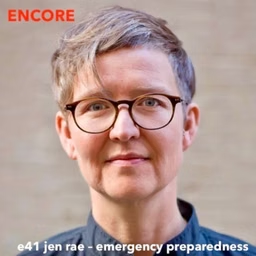
- The thing about a preparedness mindset is that you are thinking into the future and so if one of those scenarios happens, you've already mentally prepared in some sort of way for it, so you're not dealing with the shock. That's a place as an artist that I feel has a lot of potential for engagement and for communication and bringing audiences along. When you're talking about realities, accepting that reality, has the potential to push us to do other things.
Welcome to another ENCORE episode of conscient podcast.
I do this because if you missed an episode the first time it was published you can hear it again.
However this is the last ENCORE episode for a while because I’m taking break from the production of this podcast, of its sister French language version, balado conscient as well as my a calm presence Substack for what looks like undetermined period of time.
I wrote about this in my last Substack posting called pressing pause.
My plan is to meditate on my next steps in this ongoing learning and unlearning journey and do a bit of self-care as I learned to do during the Zen and the Art of Saving the Planet course last fall.
But before pressing pause, so to speak, I wanted to publish this ENCORE episode because it’s about an issue that we will be talking about increasingly in the months and years to come: which is, how do we, as artists and cultural workers, respond more effectively to emergency situations and to ongoing societal disruption.
And who better that Jen Rae, a Melbourne, Australia based artist, researcher, facilitator and educator of Canadian Red River Métis and Scottish descent.
And before going any further I want to acknowledge that Jen Rae lives, creates and works on the unceded traditional lands of the Wurundjeri, Boon Wurrung, Woi Wurrung, and Wathaurong people of the Kulin Nation and offers deep respect to their elders - past, present and emerging.
So, this 47-minute conversation was recorded, remotely, on May 10, 2021. Jen and I talked about a wide range of issues including the intersection between art, emergency preparedness, disaster risk-reduction and resilience.
Here are some of the questions that were raised:
- How do we embrace an emergency preparedness mindset? What do we increase our focus on community resilience?How can we challenge Western-centric narratives? How can we further value inclusivity? How can art and speculative fiction in particular, help free our minds and inspire action?
You’ll find some answers, also more questions, at the The Centre for Reworlding in Australia, where Jen is the creative research lead.
I’m also publishing this ENCORE episode to listen back to conversations recorded during the COVID pandemic.
For artists, in particular, it was a tough time. For a few of us it created opportunities for new forms of digital engagement but for most artists it was a nightmare of lost income, isolation and disconnection.
COVID, difficult as it was, can be thought of as a kind of test run for larger scale emergencies that will come as the climate crisis and related disasters unfold. So I’m grateful that artists like Jen Rae and The Centre for Reworlding are proactively are working, and this is a quote from their web site, to ‘advocate for the mainstream integration of culture & the arts in climate action and disaster management discourses, policy frameworks and all-years education’.
So let’s go back to 2021. And, as I did with all of my episodes at that time, you’ll hear excerpts from previous episodes that try to connect the thinking of my guests with some previous guests and that’s a lot of fun. It was a lot or work but then I had a lot of time on my hands.
So without further ado, episode 41 ENCORE. Warm thanks to Jen for this 2021 conversation and hopefully we’ll talk again if and when I come back to producing this podcast.
For more information on Jen’s work, see https://www.jenraeis.com, http://www.fairsharefare.com/ and The Centre for Reworlding.
Links to a selection of Jen’s work mentioned in this episode:
- REFUGIUM: film premiering 27 April 2021 (online and in real life - in collaboration with Claire G. Coleman)Who needs artists in a climate crisis?: Raising the Bar, 13 November 2019Refuge Talk Series: Preparing for a pandemic (21 May - 1:01:35-1:08:08), Living in a pandemic (27 May) and Recovering from a pandemic (4 June)
*
END NOTES FOR ALL EPISODES
I’ve been hosting conversations about art and the ecological crisis (ainsi qu’avec le balado conscient) with artists and cultural workers on this platform since 2020. My 7th season starts on February 7, 2027, about “how the arts, writ large, can help us live well in times of radical sharing”.
I observe this Indigenous Land Acknowledgement and apply Bodhisattva Precepts in my day-to-day work. I do my best to use “green” production methods such as https://greencalculus.com/ and https://bullfrogpower.com/. I use Whisper Transcribe AI to generate a transcript of episodes, to publish audiograms of episode excerpts and to generate first draft of episode notes. I use Deep-L to translate and Reaper to edit. I am a one-person non-profit operation out of my home, so I don’t think the use of these tools put others out of work and that this use of energy in terms of public good is justified however AI is a slippery slope and I am monitoring the situation.
You can reach me at: claude [at] conscient [dot] ca. I inivte you to subscribe to conscient podcast free on any podcast platform (Apple, Spotify, etc). You can also subscribe to the conscient podcast newsletter free on Substack (it will soon be changed from a calm presence to conscient podcast). You can see conscient podcast posting on Facebook, Instagram, Linkedin, Threads, BlueSky, Mastodon, Tik Tok or YouTube.
Thanks for listening.
Claude Schryer
Latest update on November 23, 2026