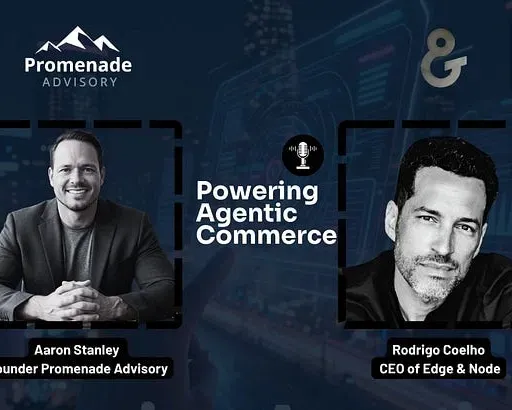
Episode #181: Live from Merge Sao Paulo with Edge & Node CEO Rodrigo Coelho
Brazil Crypto Report
🙌 You can listen to BCR on your favorite podcast platform YouTube | Spotify | Apple Podcasts
🔥 Join the BCR English language Telegram group to continue the conversation
Ola pessoal!
At Merge São Paulo, I caught up with Rodrigo Coelho, CEO of Edge & Node, which is the original team behind The Graph protocol.
We talked about one of the most exciting intersections in tech right now: agentic commerce and the future of blockchain-powered payments.
Rodrigo was born in Brazil, and his family moved to the US when he was young.
His path into Web3 started the way a lot of great origin stories do, by accident. Working out of a San Francisco co-working space in 2016, he struck up a friendship with Yaniv Tal, who was building the pitch deck for what would become The Graph.
A few years later, Rodrigo was the team’s first hire. He has been with them ever since, taking over as CEO just over a year ago.
For the uninitiated, The Graph is the indexing and querying layer that sits beneath much of Web3. If you have ever interacted with a decentralized application, you have almost certainly used it without knowing it.
Edge & Node recently launched AMP, a new product that modernizes that infrastructure for institutional use. It offers cryptographic data verification, cross-chain compatibility, and a predictable flat-fee pricing model that banks and financial institutions are finding increasingly attractive as their API costs spiral.
The part of our conversation that really stood out was the discussion around agentic commerce.
As AI agents become capable of executing real-world tasks autonomously, they need a way to pay for things. A rational agent is not going to choose a payment rail that charges a 3% fee and requires KYC when it could settle a transaction for a thousandth of a cent using stablecoins. That calculus is not even close.
Edge & Node has been working on micro-payment infrastructure since 2021. When Coinbase’s X402 standard launched, they jumped on it immediately, contributing a deferred payment scheme that allows nano-payments to be batched and settled on-chain in bulk.
It is exactly the kind of boring-but-essential plumbing that makes a new financial system actually work.
We also got into the competitive landscape, whether Visa and MasterCard can reinvent themselves before crypto rails make their fee extraction model obsolete, and why the stablecoin wars may not produce a single winner.
Key Takeaways:
* The Graph quietly powers much of Web3 data infrastructure, and Edge & Node’s new product AMP brings that technology to institutional players with compliance and cost predictability built in
* AI agents will gravitate toward crypto payment rails naturally since they cannot easily KYC, and the fee difference vs. traditional rails is not even a contest
* Ephemeral virtual cards are a short-term bridge for agentic commerce, but agent-to-agent crypto payments are where things are heading fast
* The stablecoin landscape is unlikely to produce one winner; expect a fragmented but interoperable ecosystem, much like traditional banking today
* Visa and MasterCard are paying close attention, but their 3% fee model faces a serious structural threat as X402-style rails go mainstream
Give it a listen!
Have a great week everyone,
-AWS
Brazil Crypto Report is presented by
Figment is the leading independent provider of staking infrastructure with $18B assets under stake and provides the complete solution for over 1000 institutional clients in Latin America and globally. Through its enterprise-grade infrastructure, Figment enables clients such as banks and exchanges, to earn rewards on Proof-of-Stake assets such as Ethereum and Solana, while maintaining the highest standards of security, compliance, and performance.
Recent Episodes
Get full access to Brazil Crypto Report at brazilcrypto.substack.com/subscribe