Support the show to get full episodes, full archive, and join the Discord community.
The Transmitter is an online publication that aims to deliver useful information, insights and tools to build bridges across neuroscience and advance research. Visit thetransmitter.org to explore the latest neuroscience news and perspectives, written by journalists and scientists.
Read more about our partnership.
Sign up for Brain Inspired email alerts to be notified every time a new Brain Inspired episode is released.
To explore more neuroscience news and perspectives, visit thetransmitter.org.
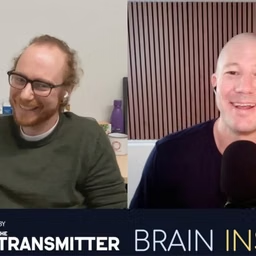
Daniel Levenstein started his NeuroAI and Dynamics Lab at Yale University about a year ago. We briefly discuss what it's like to transition from a postdoc to a principle investigator, i.e. head of the lab. But most mostly we discuss his work and ideas. Dan studies spontaneous neural activity during sleep, specially in brain areas like hippocampus and cortex, and how this internally generated spontaneous activity is related to learning and memory and navigation. Really, he used to study those processes directly through experimental brain recording datasets. These days he builds and studies models of those processes, using AI models and seeing how their dynamics and functions match what we see in brains.
Levenstein Lab
Social: @dlevenstein.bsky.social
Related papers
On the Role of Theory and Modeling in Neuroscience
The problem-ladenness of theory
Sequential predictive learning is a unifying theory for hippocampal representation and replay
0:00 - Intro
9:12 - Neuro-AI
18:23 - Experiment vs theory
20:36 - Ground vs active state neuron activity
25:38 - Beginning a lab
31:34 - Sleep and Internally generated activity
40:02 - Spiking neural networks
52:13 - Naturalistic neuro-AI
59:52 - Cognitive maps, world models
1:04:16 - Weasel words and motifs
1:08:17 - Transformers and brains
1:18:53 - AI vs biology
1:24:32 - Neuroscience theory