Support the show to get full episodes, full archive, and join the Discord community.
The Transmitter is an online publication that aims to deliver useful information, insights and tools to build bridges across neuroscience and advance research. Visit thetransmitter.org to explore the latest neuroscience news and perspectives, written by journalists and scientists.
Read more about our partnership.
Sign up for Brain Inspired email alerts to be notified every time a new Brain Inspired episode is released.
To explore more neuroscience news and perspectives, visit thetransmitter.org.
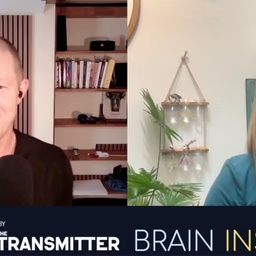
Kathryn Nave is a Leverhulme Trust Early Career Fellow at the University of Edinburgh, and the author of the book A Drive to Survive: The Free Energy Principle and the Meaning of Life. In the book, Kate dives deep into the free energy principle and active inference, which are popular approaches to studying brains, minds, and organisms in general, and which are being used in artificial intelligence. Ultimately, Kate finds these approaches come up short as explanatory frameworks for life, and autonomy, and intelligence. Instead, Kate and many others advocate a framework that Kate calls constraint closure or closure of constraints, but also goes by the name organizational closure. This is a concept from philosophy and theoretical biology that people like Alvaro Moreno and Matteo Mossio have put forth in their 2015 book Biological Autonomy. The core ideas are also found in various forms from people like Robert Rosen, Stuart Kauffman, Alicia Juarrero, Terrence Deacon, and others. We discuss what constraint closure is, why Kate thinks it's a solid foundation to build on, and what if anything it means for cognitive science and brain sciences to embrace this constraint closure view. I highly recommend the book even if you're looking for a primer on the free energy principle and active inference. As we discuss, Kate's journalism experience has helped her become a wonderful communicator of these notoriously difficult concepts.
Kathryn Nave
@kathrynnave; @kathrynnave.eurosky.social.
A Drive to Survive: The Free Energy Principle and the Meaning of Life
Related episode:
BI 241 Johannes Jaeger: Agency and the Cyborg Myth
Mentioned in the episode:
We Need To Rewild The Internet
Beyond Control: Finding the Purpose of Enactive Cognitive Science
Read the transcript.
0:00 - Intro
5:39 - Journalism back to philosophy
15:56 - How Kate got into predictive processing etc.
21:30 - Predictive processing and phenomenology
30:45 - Organizational closure
37:37 - Constraint closure beyond the single cell
45:04 - Brain as metabolic
50:12 - Basal cognition
52:13 - Degeneracy
55:08 - Neutral networks
1:00:33 - AI and autonomy
1:08:12 - Meaning and mind
1:10:02 - Why do we need brains?
1:17:33 - Reframe neuroscience?
1:23:51 - Reifying models
1:27:43 - Free energy principle and active inference
1:37:16 - Tolerating as much variability as possible