Support the show to get full episodes, full archive, and join the Discord community.
The Transmitter is an online publication that aims to deliver useful information, insights and tools to build bridges across neuroscience and advance research. Visit thetransmitter.org to explore the latest neuroscience news and perspectives, written by journalists and scientists.
Read more about our partnership.
Check out this story:
From genes to dynamics: Examining brain cell types in action may reveal the logic of brain function
Sign up for Brain Inspired email alerts to be notified every time a new Brain Inspired episode is released.
To explore more neuroscience news and perspectives, visit thetransmitter.org.
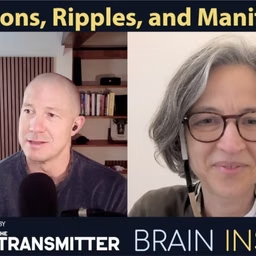
Liset de la Prida is director of the Centro de Neurociencias Cajal in Madrid, Spain, where she runs the Laboratory of Neural Circuits. Today we discuss two main topics.
What drew me to invite Liset was her work on neural manifolds, which we've talked about a lot recently on this podcast. She studies how specific subtypes of neurons affect and control neural manifolds. More on that it in a second, because what drew her to study manifolds was her work on what are known as sharp wave ripples in the hippocampus. Sharp wave ripples are generally quick bursts of oscillatory activity as found in local field potential recordings that accompany little bursty sequences of action potentials fired off by sets of neurons. Those ripples have been associated with a quick replaying of some experience an organism has had, with the thinking that by replaying those sequences of neural activity associated with an event, it's helping to consolidate the memory for that event in the cortex. Like everything else, the story isn't so simple, and we talk about some of the findings that have added to the complexity of understanding what sharp wave ripples are doing, and the varieties of sharp wave ripples.
That varieties part is related to the second main thing we discuss, which is the varieties of neuron subtypes and their roles in shaping the manifolds we've discussed a lot recently. As a reminder, manifolds are dynamic structures along which populations of neural activity unfold over time, and they have proved to be one effective way of making sense of how large populations of neurons coordinate their activity to do useful things for our cognition. Liset is interested in the relation between sharp wave ripples and manifolds, and in how specific subtypes of neurons affect manifolds and cognition in general.
Neural Circuits Lab
@lmprida.bsky.social; @LMPrida
Book:
Brain, space and time: The neuroscience of how we navigate reality, memory, or the future
Related
From genes to dynamics: Examining brain cell types in action may reveal the logic of brain function
Cell-type-specific manifold analysis discloses independent geometric transformations in the hippocampal spatial code
From cell types to population dynamics: Making hippocampal manifolds physiologically interpretable
0:00 - Intro
5:29 - Hippocampus
9:31 - Sharp wave ripples
27:30 - Oscillations and epiphenomena
33:37 - Sharp wave ripples to manifolds
43:54 - Manifolds and single neuron types
49:45 - Hippocampus and granularity of cell types
59:23 - Explanation across levels
1:19:38 - Manifolds and higher cognition
1:29:46 - Brain Space and Time