In case you need a refresher course, here are some points about the benefits of using compost in your garden, according to the UC Master Gardeners of Alameda County:
• Improves Soil Structure (Tilth): Lightens heavy clay soils and adds structure to sandy soils.
• Saves Water: Increases the water-holding capacity, reducing runoff and water usage.
• Feeds Plants & Soil Life: Adds slow-release nutrients and boosts beneficial microorganisms and earthworms.
• Balances pH: Helps to buffer and balance soil pH (acidity/alkalinity).
• Reduces Needs: Lowers the need for commercial soil conditioners and chemical fertilizers.
• Protects Plants: Encourages healthy root structure, helps control erosion, and acts as a mulch to reduce weeds and moderate soil temperature.
How to Use Compost (UCANR Recommendations)
• As a Soil Amendment: Mix 1–4 inches of compost into the top 6–10 inches of soil before planting.
• For New Beds: Apply 3-4 inches of compost and turn into the soil.
• As Top Dressing/Mulch: Apply 1-3 inches around established plants, trees, and shrubs (keeping it away from the stems).
• For Lawns: Spread a 1/2 inch layer of compost over the lawn in the spring.
• When to Apply: Fall is best for improving soil structure, but it can be applied in spring to prepare for planting.
• Materials: Composting kitchen and yard waste helps prevent landfill waste and acts as a nutrient-rich fertilizer.
For the Snarkies among you who answered, “And compost mulch provides a place for cats to poop.” Hey! Get your head out of the toilet. We covered how to thwart that in a previous newsletter.
But if you think composting is a lot of work, what if I told you that you can make compost using just two ingredients, and you don’t have to turn the pile, ever!
Now that I have your attention, here’s what Kellie Hallenbeck and Judy McClure had to say in a recent Sacramento County Master Gardener newsletter:
“The average person in the U.S. consumes about three cups of coffee per day, with landfills receiving 75% of those spent coffee grounds. Deep in landfills, grounds are robbed of oxygen, so they cannot decompose aerobically like they do in a compost pile or worm bin. Instead, coffee grounds are subject to anaerobic decomposition that can produce large amounts of methane. Methane is a greenhouse gas contributing to global warming, 25 times more potent than carbon dioxide.
Composting with coffee grounds is easy if you remember they are high in nitrogen and considered green for compost purposes. Just add a good supply of carbon-rich material, like dried leaves and shredded paper. Too much nitrogen can cause the release of ammonium gas and cause foul odors. At the same time, too little nitrogen will slow down the decomposition process.
Follow your routine of food scraps and grass clippings by mixing 1 to 2 volumes of “browns” (dry, woody materials) to 1 volume of “greens” (moist, green materials, filters with grounds). Add water and turn the mixture to add air.”
(Or, don’t turn. Read today’s podcast transcript interview further on in this newsletter (or listen to it, above) with Master Gardener and composting expert Susan Muckey to find out the why and how).
“In 2022, the Compost team experimented using only coffee grounds as the “greens” and dried leaves as the “browns” to see how the final product compares with traditional methods. Too many coffee grounds were added, resulting in the pile being too wet. The Compost team is trying again with a bin made of a hog/chickenwire ring. The pile was demoed at the March 2026 Open Garden. During you next FOHC visit, stop by the Compost area to check on the process.
How can you help to keep coffee grounds from entering the landfill? Take a bag (or 2 or 3) for your home garden during Open Garden Days.
Small changes add up over time. Just think: by adding grounds to your compost, you will be reducing waste and protecting our environment, all the while having your coffee too.”
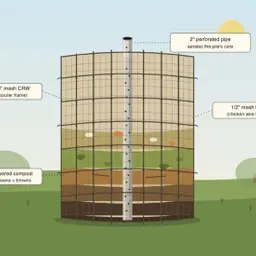
A 4’×5’ sheet of 6-inch Concrete Reinforcement Wire (CRW) wrapped end-to-end forms a cylinder roughly 19 inches across and 4 feet tall — plenty of structure to hold a season’s worth of material while letting air reach the pile from every side. The wire ends along the seam can be secured with several zip ties through the opposing squares to lock it shut, so no special tools are needed (and you can pop it open to turn the pile, if necessary).
The chicken-wire or 1/2” hardware-cloth liner goes on the inside of the Concrete Reinforcement Wire cylinder so it’s held in place by the pile’s outward pressure rather than fighting it. That fine inner layer keeps loose material from spilling through the big 6-inch openings while still letting the whole bin breathe. Inside, layers of browns (shredded leaves) and greens (coffee grounds) are alternated, a 3 or 5 gallon bucket of each at a time, until the bin is full.
The 2-inch perforated pipe runs straight down the center of the bin, poking a few inches above the top of the pile and reaching all the way to the ground. Holes drilled in a staggered pattern along its full length to more easily water the middle of the pile with a garden hose. The holes also let oxygen drift into the middle of the heap — the spot that otherwise goes anaerobic and slows down the composting process. PVC, ABS, or even a length of corrugated drain pipe all work; just drill 1/4’-3/8” holes every couple of inches around the pipe and cap or screen the top so it doesn’t fill with debris.
The No-Turn Compost Pile TRANSCRIPT
We Talk with Sacramento County Master Gardener and compost expert Susan Muckey.
Farmer Fred:
[0:00] Did you know the average person in the United States consumes about three cups of coffee per day?
Problem is, landfills are receiving about 75% of those spent coffee grounds. And those coffee grounds are buried deep into landfills, and then the grounds are robbed of oxygen so they can’t decompose. And what happens then, they become anaerobic and poof, they produce large amounts of methane. Methane is a greenhouse gas contributing to global warming, 25 times more potent than carbon dioxide. Did you know you could use those coffee grounds instead of sending it to a landfill? Put it in your compost pile. In fact, you could even make a compost pile using nothing but coffee grounds and leaves. Does that actually work? It just so happens they tested that here at the Fair Oaks Horticulture Center. We’re here at a workday where the Sacramento County Master Gardeners are hard at work, and we’re talking with Composter Supreme Susan Muckey, Master Gardener. And Susan, you did a little experiment back in 2022 on this.
Susan Muckey:
[1:08] Yes, we did. It was great. We took the tomato cages, which were pretty big tomato cages. They weren’t like the little skinny ones. And then we put chicken wire around them, and we started this in November. And actually, if I were to do this again, I would probably start it as early in the fall as I could, especially as soon as I have enough leaves to fill up a tomato cage. And then the hunt begins. You can go to Starbucks or some of the other places if you don’t drink coffee. And just use, I would say, 50-50 ratio of coffee grounds and leaves. And what happens is by six months, if it rains, and if it doesn’t rain, you’re probably going to have to water it a little bit. But if it rains, you’re going to have incredible compost. The most beautiful I have ever seen.
Farmer Fred:
[2:02] Let’s talk a little bit about the tomato cages you used. I think we’re standing next to one of them. That was probably a prime candidate for that project. And this is made out of concrete reinforcement wire. And those sheets are usually four by five or thereabouts, maybe four by six, and just formed into a circle. Sometimes they’re secured by zip ties. Sometimes people will bend the prongs together to secure it. But it gets you a tomato cage, six-inch mesh, that’s about five feet tall. and probably two feet wide. So that’s the size you want. And then you would wrap the outside of this with chicken wire.
(FREDNOTE: others who have done this recommend putting the chicken wire or hardware cloth on the INSIDE of the tomato cage.)
Susan Muckey:
[2:40] Yes, because, well, I decided to do a beta test. And when we did it, and this is not in front of an audience, but we did it and we poured the leaves in. And guess what happened? All the leaves fell out. So then we said, oh, well, we probably need to put some chicken wire around it. And I find, too, that shredded leaves probably would work better than the regular leaves. And if you don’t have a leaf shredder, your lawnmower will work just as well.
Farmer Fred:
[3:13] I use my mulching mower for that. And I also use my weed whacker. And I’ll stick the leaves in the fall into a metal trash can. Remember 32-gallon metal trash cans? Well, they’re still around. And just put my string trimmer into that and cut them up, and it works fine. And in this day and age, you can save those leaves forever if you’ve got a big enough compost sack where you can just keep those leaves in until you need them.
Susan Muckey:
[3:47] Yesterday, I shredded five bags of leaves from last year and they were fine. The only problem is if you hadn’t shred them in the fall when you collected them, it’s very hard to shred them. They’re like a mass of muck. And so I could just take the top layer because those shredded just fine. But the bottom ones, because I think during the year, what happens is the moisture that’s in the leaves kind of goes down to the bottom, and now you’ve got all this moisture, even though the leaves were dry when I put them in the bag.
Farmer Fred:
[4:23] “Massive Muck” was the name of my band in high school, in case you didn’t know. The secret to a successful compost pile is a 50-50 mix of what are called greens and browns. Those fallen leaves, they’re browns. And I’m still trying to wrap my head around, how can coffee grounds be green?
Susan Muckey:
[4:40] Because they’re a source of nitrogen. And actually, once they’ve gone through the process of making coffee and brewing and whatnot, they are no longer extra acidic. Because that’s what people are afraid to use, coffee grounds, because they think they’re too acidic. But once you’ve processed them through the coffee-making process, I use instant coffee, so I don’t have that problem. But anyway, yeah, they will not be acidic.
Farmer Fred:
[5:08] How do you stack them when you’re adding green, when you’re adding brown? How big is each layer?
Susan Muckey:
[5:16] Okay, so what we did about a month ago, two months ago, is I did an interactive mini talk with my audience. And after I talked a little bit about compost and the components of compost, we went over to our trusty tomato cage and I had each one of them dump a bucket into it, of alternating leaves with coffee grounds.
Farmer Fred:
[5:40] Five-gallon bucket?
Susan Muckey:
[5:41] Well, some of them were five-gallon. I think the coffee ground buckets were smaller, like maybe the three-gallon ones from Lowe’s and Home Depot. And they all, one at a time, did it. And then we had somebody sitting there with the hose watering. It became their compost pile. And then we did a cheer when we finished it.
Farmer Fred:
[6:01] Now, of course, the secret to a successful compost pile is also air. So do you have to turn that pile?
Susan Muckey:
[6:08] No. That’s why it’s called a no-turn compost pile. And what happens is the materials you put together, they all start interacting with each other. And pretty soon, within about six months, you’re going to have compost.
Farmer Fred:
[6:22] Well, probably below what you can see on top. So the compost takes up how much of the bottom of the tomato cage?
Susan Muckey:
[6:28] Okay. So when we did the original experiment, I kept looking at the tomato cage and it still looked like nothing had happened, only that it had shrunk. It went to about half the size. And I said, okay, well, I’m tired of waiting. So we tipped it over and the outside was still the leaves because we didn’t turn it. But what came out of it was to die for. Even Farmer Fred would die for it.
Farmer Fred:
[7:00] Having a smart pot compost sack, I know that story well because I fill it with the shredded leaves and you look at the top and you go, nothing’s happening there. But then if you dump it out, all of a sudden there’s all this beautiful brown and black compost.
Susan Muckey:
[7:15] That’s right. That’s right. That’s exactly right. And I don’t remember because it was several years ago, four years ago, but I don’t remember if there was any worms in there. I can’t really remember if there were, but if there were worms in there, they probably would have aided in the decomposition process.
Farmer Fred:
[7:32] Now, obviously you’re using, if you’re using a three gallon bucket of coffee grounds, that’s probably more coffee than you’re going to make in a week, making your 10 cups (!) of coffee each day. So a lot of coffee shops will gladly give you a big bag or two. And that happens here at the Fair Oaks Horticulture Center. But is that just for Master Gardeners or anybody who shows up on an Open Garden day?
Susan Muckey:
[7:53] I think it’s for anybody. And actually, what I’ve done is if you give one of the coffee shops a five-gallon bucket, they’ll fill it for you.
Farmer Fred:
You just have to have a lid.
Susan Muckey:
Yeah, it should have a lid or a three-gallon if you can’t carry five gallons. But I find they don’t necessarily want to keep a lot of coffee grounds around. Now Starbucks, I know they’ll bag it up for you, you know if you’re really a true gardener you don’t want like just a little bag of coffee grounds you want a manly size bag of coffee grounds. they’ll say ‘Oh do you want us to put it in little bags?’ and i’ll say ‘No just give me a big bag.’ ‘Can you carry it?’ ‘Yes i can carry it.’
Farmer Fred:
[8:38] How big is the big bag?
Susan Muckey:
[8:39] It’s a garbage bag oh okay it’s probably a good 30 pounds.
Farmer Fred:
[8:44] You can drag it to your car.
Susan Muckey:
[8:45] No i wouldn’t want to drag it to my car, leaving A trail of coffee grounds.
Farmer Fred:
[8:51] You know. Well, it’s in a garbage bag.
Susan Muckey:
[8:53] Yes, it’s in a garbage bag, but as you’re dragging it. And also, you do not want it in your car. You know, coffee grounds all over your car.
Farmer Fred:
[9:03] How do you get it home?
Susan Muckey:
[9:05] I do carry it in my car, but it doesn’t have a hole in the bag. All right.
Farmer Fred:
[9:10] Well, use two garbage bags, one inside the other.
Susan Muckey:
[9:14] Yes, yes, yes. And I do try to take it out as soon as possible because my husband always says, your car smells like a garden.
Farmer Fred:
[9:22] Well, that’s putting it politely.
Susan Muckey:
[9:24] I know. He says, between the compost and all the other stuff you put in here, he doesn’t ride with me very often. Okay.
Farmer Fred:
[9:31] Well, my car usually smells of chicken manure and things like that. All right. So if you’re working with a converted tomato cage that is like five feet wide by two feet wide, If you went to get enough coffee grounds to fill up, say, half of it, it would probably be, and if it’s a garbage bag full, you’d probably need about two or three of those garbage bags.
Susan Muckey:
[9:58] Yes, it’s quite a bit. And you have to realize, too, when you put the leaves in, it kind of fills in between the spaces in the leaves. And so you’re going to need more than you think. And it’s better to have more than less. All right.
Farmer Fred:
[10:11] So think about that. If you never starteded a compost pile and you don’t want to have to turn it, you don’t have to do much to this one, except maybe add water regularly.
Susan Muckey:
[10:19] Yes. If it doesn’t rain. Yeah.
Farmer Fred:
[10:21] How often do you wet it?
Susan Muckey:
[10:23] Well, when we did it, we didn’t do anything to it. You know, when we did it in 2022, it must have rained because we didn’t do anything.
Susan Muckey:
[10:31] We didn’t turn it. We didn’t do anything. Since we started one about two months ago, what I would probably do is I would put a PVC pipe in the middle of it so that when I watered it, because we don’t know how much it’s going to rain, when you water it, the holes in the PVC pipe would disperse the water throughout a little bit better.
Farmer Fred:
[10:52] What diameter pipe is this?
Susan Muckey:
[10:55] I would probably use, well, for us, we use whatever we have. We live on a farm, so we just use whatever we have. But if you have an inch, that’d probably work.
Farmer Fred:
[11:04] Yeah, inch minimum, I would think, just to be able to stick a hose in it.
Susan Muckey:
[11:07] Right, right, right, right, right.
Farmer Fred:
[11:09] And if you’ve got a drill, you’re set.
Susan Muckey:
[11:11] That’s right. That’s right.
Farmer Fred:
[11:12] How big were the holes?
Susan Muckey:
[11:14] I don’t think it matters. I mean, you know, the only problem with PVC pipe is it’s really hard to, especially if you get really hard PVC pipe, I would go with softer stuff that’s not so hard to drill.
Farmer Fred:
[11:30] Oh, okay. That’s a good point because there are some thick three inch lines you can buy. Oh, yeah.
Susan Muckey:
[11:35] Yeah. I did a worm tower where, you know, you put a huge drainage pipe in your soil. And man, drilling those holes was terrible. It was very, very hard to do.
Farmer Fred:
[11:49] Now, I know somebody who did that. They had one next to a tree, and I think he drilled a hole that was about six feet deep and stuck a pipe in and would only water it through that perforated pipe. It seems like that would only water one side of the tree.
Susan Muckey:
[12:03] Well, this was a worm tower. And the worm tower would mean you would build a worm bin basically inside of this worm tower that you submerge into your raised bed or whatever you’re going to put it. Oh, okay, yeah. Yeah, yeah. So, no, no, it’s not for watering. It’s for raising the little cuties, the little red wigglers.
Farmer Fred:
[12:27] It sounds like an African keyhole garden.
Susan Muckey:
[12:29] Pretty much, yeah, yeah. Okay.
Farmer Fred:
[12:31] All right. We have an article about that. I’ll have a link to it in today’s show notes about that article, where you can learn about submerging something into your yard for the worms.
Susan Muckey:
[12:43] In fact, I don’t know if we still have it here, but we used to have somebody put in a five-gallon bucket, and they were just throwing all their scraps in there. And I’m not sure if we still have it or not, but we did it for several years.
Susan Muckey:
[12:55] So anyway, it’s just another way. There’s always a way that suits your style of life.
Farmer Fred:
[13:02] Okay. Now I have a personal question. I tore out some chard that has turned rather bitter. That happens in May. I’ve got the plants out of the ground. I want to feed the worms, the chard. What’s the best way to chop that up? They’re big leaves.
Susan Muckey:
[13:21] Clippers.
Farmer Fred:
[13:21] Oh, thank you.
Susan Muckey:
[13:24] Actually, my daughter, we, you know, so it’s bitter right now. Because what we do with the chard, with the big leaves, is we cut out the stem, and my daughter sautés it. And then she cuts all the other stuff up and puts a bunch of seasoning in it. It’s delicious.
Farmer Fred:
[13:39] Can I have your daughter?
Susan Muckey:
[13:40] Yes, you can. She actually lives in Folsom, too.
Farmer Fred:
[13:45] Oh, great. Well, I still think I’ll feed the worms the chard.
Susan Muckey:
[13:47] Oh, they’ll enjoy it. Don’t put any onions in there.
Farmer Fred:
[13:51] No, no.
Susan Muckey:
[13:52] Or garlic.
Farmer Fred:
[13:52] Yeah, it’s just I’m going to have to spend an afternoon with scissors.
Susan Muckey:
[13:56] Yes, that’s right. All right. Or you could put it in your freezer and that will break it down and then you could feed it to the worms.
Farmer Fred:
Directly?
Susan Muckey:
Yes.
(FREDNOTE: THAT WAS THE TIP OF THE DAY! TIP OF THE DAY!)
Farmer Fred:
[14:06] Oh, God bless you. Thank you for that. Okay. I don’t even have to cut the leaves in half? No. No.
Susan Muckey:
[14:12] Because, you know, when you put like strawberries or something in the freezer, what happens? they turn to mush. Yeah.
Farmer Fred:
[14:20] That’s all. And you’ve always said, every talk I’ve ever heard you give about vermicomposting is, worms love mush.
Susan Muckey:
[14:26] Oh, they do. The ickier, the better. If you look in the back of your refrigerator in the bottom drawer, that slime that you’ve accidentally forgotten about, they would go, yum, yum, yum, because they don’t have teeth and they’re going to suck it in to their body. That’s the only way they can access the food that we give them.
Farmer Fred:
[14:48] How long should I keep the chard in the freezer?
Susan Muckey:
[14:51] Until it gets frozen.
Farmer Fred:
[14:53] Well, that’s it. So like a few days? Yes. And it turns to mush that quick?
Susan Muckey:
[14:57] Of course.
Farmer Fred:
[14:59] Wow. All right. The stuff you learn when all you came to talk about was coffee grounds and leaves. But that’s how you do it. There’s an easy plan for you: the No-Turn, Easy Compost Pile. And we will have this article in today’s newsletter about how you can have your coffee, keep the grounds and reduce the methane and all the problems we have with climate change, I guess. It’s just basically small changes add up over time. And by adding grounds to your compost, you’ll be reducing waste and protecting our environment and still have your coffee as well. Susan Muckey, Sacramento County Master Gardener, who is always wearing a composting shirt, usually one with a worm on it.
Susan Muckey:
[15:40] Of course.
Farmer Fred:
[15:40] Of course. Thank you so much.
Susan Muckey:
[15:42] You’re welcome.
Beyond The Garden Basics is a reader-supported publication. Please become a paid subscriber. Heck, today’s tip about freezing oversized, bitter, bolting leaves of greens before feeding it to your worms is worth the price!
Fred Hoffman is also a University of California Cooperative Extension Master Gardener in Sacramento County. And he likes his bikes.
This is a public episode. If you'd like to discuss this with other subscribers or get access to bonus episodes, visit gardenbasics.substack.com/subscribe