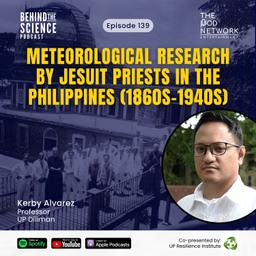
Ep139 - Meteorological Research by Jesuit Priests in the Philippines (1860s–1940s)
Behind The Science Podcast
In this episode, we talk with Dr. Kerby Alvarez, a historian at the Department of History, University of the Philippines Diliman, about his study tracing the history of Philippine meteorology. Long before PAGASA existed, the Observatorio Meteorológico de Manila (OMM) — founded by Jesuit priests in 1865 — and its successor, the Philippine Weather Bureau (PWB) spent nearly a century turning typhoons into a subject of serious scientific study.
Drawing on archives in the Philippines, the US, and Spain, Dr. Alvarez shows how these institutions published hundreds of reports, built a regional network with weather observatories across Asia, and even got caught in a diplomatic dispute with Hong Kong's observatory in 1899. As a historian, he traces not just what these scientists discovered, but how their writing, data-keeping, and international collaborations were shaped by the political currents of Spanish and American colonial rule in the Philippines.
⌛Chapters
00:01:51 Intro and welcoming Dr. Kerby Alvarez
00:03:15 Getting to know Dr. Alvarez as a historian
00:14:55 Filipino holidays and historical memory
00:22:24 The paper: a history of Philippine meteorological science
00:26:42 Building the Manila Observatory and Philippine Weather Bureau
00:48:11 The Manila–Hong Kong observatory feud
00:50:34 Funding historical research, other disasters studied, and advice for aspiring historians
01:02:07 Closing
📚Reference: Alvarez KC. 2025. Scientific textualizations of tropical cyclones in the Philippines: the scientific activities of the Observatorio Meteorológico de Manila (OMM) and Philippine Weather Bureau (PWB), 1860s–1940s. Hist Meteorol. 12:1–26.
🤝Behind The Science Podcast is in partnership with the UP Resilience Institute