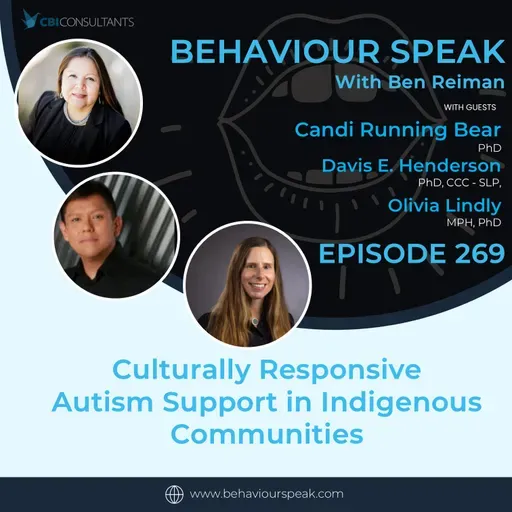
Culturally Responsive Autism Support in Indigenous Communities with Dr. Candi Running Bear, Dr. Davis E. Henderson, and Dr. Olivia Lindly
Behaviour Speak with Ben Reiman
What does truly culturally responsive autism support look like—and who should lead it?
In this episode, Ben speaks with Dr. Davis Henderson, Dr. Candi Running Bear, and Dr. Olivia Lindly about their work adapting the Parents Taking Action program for Diné (Navajo) families. Together, they unpack how geography, language, family structure, and cultural values shape access to autism services—and how their team is working alongside communities to close those gaps.
From telehealth delivery across vast rural regions to adapting AAC tools in Indigenous languages, this conversation highlights what it really takes to move beyond “one-size-fits-all” care.
The team also shares their innovative next step: empowering parents to train educators—flipping the traditional model of expertise on its head.
What You’ll Learn
Why autism awareness and services remain limited in many Indigenous communities
How the Diné Parents Taking Action program was culturally adapted
The role of community advisory boards in ethical, effective research
How telehealth unexpectedly improved access and connection
Why AAC must be culturally and linguistically responsive
The importance of extended family systems in caregiving
How parents are being empowered to train educators
What culturally responsive autism assessment still gets wrong—and how to improve it
Key Topics & Highlights
Adapting evidence-based interventions for Indigenous communities
Barriers: rural geography, transportation, internet, and systemic gaps
Language access—including the need for autism terminology in Navajo
Cultural values like Hózhó and their role in care
AAC innovation: from iPads to paper-based systems in low-resource settings
Community connection as an intervention outcome
Expanding work to Hopi and other Indigenous communities
Watch on YouTube: https://youtu.be/XWkC-7l19is
Continuing Education Credits (https://www.cbiconsultants.com/shop)
BACB: 1.0 Ethics
IBAO: 1.0 Cultural
QABA: 1.0 Ethics
CBA/CPD: 1.0 Cultural Diversity
Follow us!
Instagram: https://www.instagram.com/behaviourspeak/
LinkedIn: https://www.linkedin.com/in/behaviourspeak
TikTok: https://www.tiktok.com/@behaviorspeak
About the Guests
Dr. Davis Henderson – Associate Professor, Northern Arizona University. Navajo researcher focused on communication disorders and culturally responsive care.
https://directory.nau.edu/?person=dh929
Dr. Candi Running Bear – Assistant Professor, University of New Mexico. Former special education teacher with deep experience in early childhood education on the Navajo Nation.
https://coehs.unm.edu/faculty-staff/profiles/running-bear-candi.html
Dr. Olivia Lindly – Associate Professor, Northern Arizona University. Public health researcher focused on maternal and child health and autism services.
https://www.linkedin.com/in/olivia-lindly-phd-mph-3323306/
https://directory.nau.edu/?person=ojl28
Research Discussed:
Lindly OJ, Running Bear CL, Henderson DE, Lopez K, Nozadi SS, Vining C, Bia S, Hill E and Leaf A (2023). Adaptation of the Parents Taking Action program for Diné (Navajo) parents of children with autism. Front. Educ. 8:1197197. doi: 10.3389/feduc.2023.1197197
Lindly, O., Running Bear, C., Henderson, D. E., Kirby, B. R., Begay, V., Shui, A., Dababnah, S., & Magaña, S. M. (2025). Pilot study of a strengths-based education program for Diné (Navajo) families of autistic children: Feasibility, fidelity, acceptability, and initial outcomes. Research in Autism, 127, 202658. https://doi.org/10.1016/j.reia.2025.202658
Related Episodes:
https://www.behaviourspeak.com/e/episode-37-the-realities-of-autism-in-first-nations-communities-in-canada-with-grant-bruno-phd-candidate/
https://www.behaviourspeak.com/e/episode-147-culturally-responsive-care-in-indigenous-communities-with-dr-jaxcy-turietta/
https://www.behaviourspeak.com/e/behavior-analysis-and-indigenous-ways-of-being-with-leslie-peters