About
SONS of LIBERTY Radio with Bradlee Dean
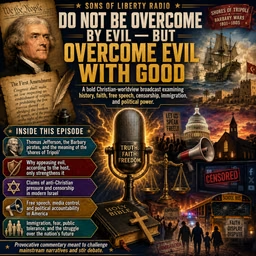
Do Not Be Overcome By Evil, But Overcome Evil With Good
Overcoming Evil With Good: Free Speech, Political Power, and the Duty to Act
Summary
Opening Historical Frame and Christian Worldview
The episode opens with a prerecorded historical narrative about Thomas Jefferson, the Barbary Coast, early American naval conflict, and a quotation attributed to Elbridge Gerry. It then states the program’s Christian biblical worldview and its belief that Christian ethics underlie American government and society. Bradley Dean introduces himself and describes the program as one in which listeners should think for themselves rather than make other people the measure of their conduct. He also promotes the program’s presence at the Minnesota State Fair and directs listeners to the show’s websites and call-in number. This opening establishes the episode’s recurring themes of religious conviction, political independence, and resistance to perceived threats to liberty.
Israel, Zionism, Christianity, and Political Influence
Dean devotes a major portion of the program to his interpretation of modern Israel, Zionism, Christianity, and American political influence. He plays an embedded news clip about proposed Israeli legislation concerning Christian proselytizing and then links that report to additional claims about Christian communities near Bethlehem. He repeatedly distinguishes, in his own framing, between Jewish people and Zionists, while alleging that American politicians are influenced or controlled by AIPAC and other foreign interests. He also criticizes prominent Christian leaders and politicians whom he regards as compromised or misleading. Throughout this section, these claims are presented as Dean’s arguments and interpretations rather than independently established facts.
Free Speech, Censorship, and Government Accountability
A central thread of the episode is Dean’s concern that free speech is being restricted by government, courts, media organizations, and technology companies. He invokes quotations attributed to George Washington, Benjamin Franklin, and Montesquieu to argue that free expression is essential to liberty and resistance to tyranny. Dean says that attorneys have been contacted regarding censorship he believes the program has experienced, and he criticizes the Supreme Court and technology executives for what he views as failures to protect the First Amendment. He repeatedly asks listeners whether commentators are pointing people toward law and justice or merely distracting them without producing a resolution. The program’s title theme—overcoming evil with good—is used as a moral frame for political and civic action.
Immigration, Islam, and Embedded News and Video Clips
Much of the second half focuses on Dean’s views about Muslim immigration, political representation, and public policy in Minnesota, Michigan, New York, and Europe. He plays or describes a Ferndale, Michigan report about a Muslim woman who was required to remove her hijab during booking after a traffic stop, and he comments critically on the report and her legal complaint. He later revisits an old school-bus video in which a woman described as Muslim makes threatening statements in front of children and a bus driver confronts her. Dean also references Abdul El-Sayed, a Philadelphia educational video, and political developments involving Mamdani, using these examples to argue that government policy and public apathy have enabled what he describes as a broader political and cultural threat. Several claims and numerical comparisons in these segments are preserved as spoken and are not externally verified in this transcript cleanup.
Political Leadership, Fear, and Civic Responsibility
Dean criticizes Speaker Mike Johnson, Donald Trump, and a range of Republican political figures, arguing that their rhetoric does not match the legal or political action he believes is required. He plays a short Mike Johnson clip warning about political figures who are dangerous to families, then argues that government officials helped create the very conditions they now use to frighten the public. Dean repeatedly says Americans should not take counsel from fear and should instead demand enforcement of law and accountability from representatives. He also argues that citizens themselves bear responsibility when they tolerate policies or officials they oppose. In his framing, the problem is not simply that political groups gain power, but that the larger public permits it through apathy, surrender, or failure to act.
Promotions, Testimonials, and the Closing Call to Action
Commercial and promotional breaks remain part of the corrected transcript because they occur in the recording. These include a Content Media Conference promo, Sons of Liberty fundraising and event announcements, a Liberty Sentinel message from Alex Newman, testimonials from Tom Raymond and Lisa Mead, a Sunday church invitation, and a BBS Radio TV network promo. The host also repeatedly acknowledges technical problems with the call-in line and apologizes to callers he cannot bring on air. Near the end, he compares U.S. demographic and political conditions with claims about Muslim political representation in the United Kingdom and discusses a Minnesota voter-vouching clip. He closes by arguing that citizens are being dispossessed because of what they tolerate and ends with his brief program sign-off.
Do Not Be Overcome By Evil, But Overcome Evil With Good
Overcoming Evil With Good: Free Speech, Political Power, and the Duty to Act
Summary
Opening Historical Frame and Christian Worldview
The episode opens with a prerecorded historical narrative about Thomas Jefferson, the Barbary Coast, early American naval conflict, and a quotation attributed to Elbridge Gerry. It then states the program’s Christian biblical worldview and its belief that Christian ethics underlie American government and society. Bradley Dean introduces himself and describes the program as one in which listeners should think for themselves rather than make other people the measure of their conduct. He also promotes the program’s presence at the Minnesota State Fair and directs listeners to the show’s websites and call-in number. This opening establishes the episode’s recurring themes of religious conviction, political independence, and resistance to perceived threats to liberty.
Israel, Zionism, Christianity, and Political Influence
Dean devotes a major portion of the program to his interpretation of modern Israel, Zionism, Christianity, and American political influence. He plays an embedded news clip about proposed Israeli legislation concerning Christian proselytizing and then links that report to additional claims about Christian communities near Bethlehem. He repeatedly distinguishes, in his own framing, between Jewish people and Zionists, while alleging that American politicians are influenced or controlled by AIPAC and other foreign interests. He also criticizes prominent Christian leaders and politicians whom he regards as compromised or misleading. Throughout this section, these claims are presented as Dean’s arguments and interpretations rather than independently established facts.
Free Speech, Censorship, and Government Accountability
A central thread of the episode is Dean’s concern that free speech is being restricted by government, courts, media organizations, and technology companies. He invokes quotations attributed to George Washington, Benjamin Franklin, and Montesquieu to argue that free expression is essential to liberty and resistance to tyranny. Dean says that attorneys have been contacted regarding censorship he believes the program has experienced, and he criticizes the Supreme Court and technology executives for what he views as failures to protect the First Amendment. He repeatedly asks listeners whether commentators are pointing people toward law and justice or merely distracting them without producing a resolution. The program’s title theme—overcoming evil with good—is used as a moral frame for political and civic action.
Immigration, Islam, and Embedded News and Video Clips
Much of the second half focuses on Dean’s views about Muslim immigration, political representation, and public policy in Minnesota, Michigan, New York, and Europe. He plays or describes a Ferndale, Michigan report about a Muslim woman who was required to remove her hijab during booking after a traffic stop, and he comments critically on the report and her legal complaint. He later revisits an old school-bus video in which a woman described as Muslim makes threatening statements in front of children and a bus driver confronts her. Dean also references Abdul El-Sayed, a Philadelphia educational video, and political developments involving Mamdani, using these examples to argue that government policy and public apathy have enabled what he describes as a broader political and cultural threat. Several claims and numerical comparisons in these segments are preserved as spoken and are not externally verified in this transcript cleanup.
Political Leadership, Fear, and Civic Responsibility
Dean criticizes Speaker Mike Johnson, Donald Trump, and a range of Republican political figures, arguing that their rhetoric does not match the legal or political action he believes is required. He plays a short Mike Johnson clip warning about political figures who are dangerous to families, then argues that government officials helped create the very conditions they now use to frighten the public. Dean repeatedly says Americans should not take counsel from fear and should instead demand enforcement of law and accountability from representatives. He also argues that citizens themselves bear responsibility when they tolerate policies or officials they oppose. In his framing, the problem is not simply that political groups gain power, but that the larger public permits it through apathy, surrender, or failure to act.
Promotions, Testimonials, and the Closing Call to Action
Commercial and promotional breaks remain part of the corrected transcript because they occur in the recording. These include a Content Media Conference promo, Sons of Liberty fundraising and event announcements, a Liberty Sentinel message from Alex Newman, testimonials from Tom Raymond and Lisa Mead, a Sunday church invitation, and a BBS Radio TV network promo. The host also repeatedly acknowledges technical problems with the call-in line and apologizes to callers he cannot bring on air. Near the end, he compares U.S. demographic and political conditions with claims about Muslim political representation in the United Kingdom and discusses a Minnesota voter-vouching clip. He closes by arguing that citizens are being dispossessed because of what they tolerate and ends with his brief program sign-off.