About
Prophecy in the Spotlight with Dan Goodwin
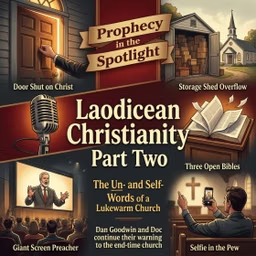
Laodicean Christianity Part Two: The "Un-" and "Self-" Words of a Lukewarm Church
Dan Goodwin and co-host Charles Hiltibidal continue their study of Revelation's Laodicean church, working through two parallel word lists, hyphenated "un-" words and "self-" words, that they say describe today's lukewarm, self-centered Christianity.
Picking Up Laodicean Christianity, Part Two
Dan Goodwin opens Prophecy in the Spotlight by telling viewers this episode continues last week's study of Laodicean Christianity, the final church of Revelation chapter three. He reviews the passage, verses fourteen through eighteen, where Christ tells the angel of the Laodiceans that He knows their works, that they are neither cold nor hot, and that because they are lukewarm He will spew them out of His mouth. Goodwin reads the church's own words, "I am rich, and increased with goods," and calls it a description that fits modern believers who have too much stuff to even consider the mission field. He and co-host Charles Hiltibidal, called Doc, joke about the storage shed industry, with Goodwin recalling a man from decades ago who was told buying a storage facility business guaranteed income for life because everyone has more belongings than space. Goodwin notes Revelation chapter four opens with a door opened in heaven, which the two read as the rapture, insisting the church age clock is ticking down toward the end.
The List of Un- Words Returns
Hiltibidal explains that months of research produced a list of hyphenated "un-" words describing today's lukewarm believers, beginning with unattached, people connected to no accountable membership, and unaccountable, since many reject the authority God placed in a pastor as under-shepherd. Goodwin ties accountability to Hebrews thirteen, where believers are told to submit to those who watch for their souls and must give an account, distinguishing it from Romans thirteen's command to submit to government. The two move through unreliable, unconcerned, unfaithful and unwilling, Goodwin lamenting that the biblical cry "here am I, Lord, send me" seems absent from today's missionaries, though Hiltibidal defends that most missionaries his own church supports remain solid in doctrine. They continue through unchurched, uncommitted, and unscriptural, which Hiltibidal ties to confusion over which Bible translation to trust, recalling a podcaster who favors the ESV and has quoted three different Bibles in one message, creating, Goodwin says, a dangerous situation where the listener decides which Bible is right.
Accountability, Authority, and the Under-Shepherd
The conversation turns to church governance, with Hiltibidal warning that the greater danger facing the modern church is not outside opposition but a creeping Laodiceanism among believers themselves. He criticizes congregations that strip denominational names from their signs to seem generic and that replace a single pastor with a leadership team, insisting that even Paul and Barnabas worked as a team under clear order, God the Father, the Son, the Holy Spirit, down to the under-shepherd. Goodwin agrees that the buck does not stop with a deacon board, noting that even board-run churches usually have one man whose vote everyone watches, making him the real authority, sometimes above the pastor himself. Hiltibidal says he finds this grieving to watch, comparing his reaction to Christ being sick at His stomach over the Laodiceans. Goodwin adds that many pastors have simply given up their authority because the culture pressures them to measure success by numbers and money rather than faithfulness to scripture, so they stop fighting and drift from hot into lukewarm.
From Un- Words to Self- Words
Hiltibidal reveals that his "un-" word list grew out of a parallel list of "self-" words describing the same lukewarm believers, beginning with self-centred and self-orientated, which Goodwin links to a selfie generation obsessed with what church can offer them rather than what doctrine it teaches. Hiltibidal recalls a statistic of selfies taken worldwide running into the millions, maybe billions, and says the habit symbolizes a self-centred culture, though he admits he has rarely taken one himself. Goodwin remembers a sermon from Dr. Bob Gray heard decades earlier at Bible college, whose first point on building a church was simply "don't," since Jesus said He would build His church and the pastor's job is to build people instead. That leads into self-made, with Hiltibidal describing believers who insist they need no doctrine or help from anyone. Goodwin recalls privately urging Pastor Greg Neal of Emmanuel Baptist Church, a church he recommends to listeners near Jacksonville, Florida, to stay humble no matter how much God uses him.
Selfish, Self-Satisfied, and the Old Nature
Hiltibidal continues through selfish, warning that selfish believers become reservoirs who keep everything for themselves rather than a river God can use, and he praises missionaries his church supports in Brazil and the Philippines who planted several churches by sending people out instead of keeping one large congregation. Goodwin adds that a church quietly running two thousand people across several daughter congregations gets no bragging rights, unlike one claiming eight hundred under one roof. The men move through self-absorbed and self-authoritative, then self-infatuated and self-satisfied, which Hiltibidal says leaves no room for growing spiritually once a believer feels they have arrived. Goodwin recalls, uncertain of the exact reference, a figure from an old biography who told God to stop pouring out His spirit because he could not bear any more, a detail that stays unclear in the broadcast. Hiltibidal argues much of modern Christianity tries to Christianize the old nature, letting fighters and brawlers simply redirect their old drives into spiritual-sounding causes instead of surrendering them.
Self-Devoted, Self-Bewitched, and a Call to Readiness
As time runs short, the men reach self-devoted, with Goodwin recalling a preacher who opposed ten-foot video screens in sanctuaries because they make the preacher "bigger than life." Hiltibidal ties self-bewitched to believers convinced they understand scripture better than anyone else, quoting Paul's warning that a man who thinks himself something when he is nothing deceives himself. They close on self-indulgent, which Hiltibidal calls the core of Laodicean Christianity, the old nature wanting to satisfy the flesh while still calling itself Christian, so that preachers avoid naming specific sins by name. He compares the pattern to Roman Catholic indulgences, paying or confessing away guilt rather than confronting it, and to modern "green" purchases that let people buy their way clear of responsibility. Goodwin notes they have run out of time without finishing the list and suggests continuing it in a future update. He closes by asking viewers whether the list struck a nerve, inviting anyone unsure of their salvation to contact the show, and signing off to keep their eyes on the sky.