Rhode Island's Nonprofit Crisis - Singer, Chief Strategy & Audience Officer, Ocean State Media
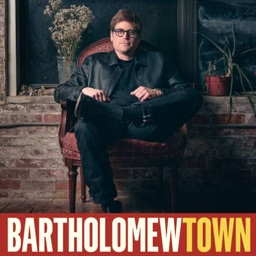
Bartholomewtown
Send us Fan Mail
read Singer's piece here:
https://www.oceanstatemedia.org/economy/2026-09-28/we-do-not-want-to-turn-people-away-r-i-nonprofits-face-financial-crisis
Rhode Island’s nonprofit fiscal cliff and the future of local public media
Bill Bartholomew talks with Singer, Chief Strategy and Audience Officer at Ocean State Media, about a growing crisis hitting Rhode Island nonprofits, public media, and the people who rely on both. The conversation starts with Singer’s reporting on how funding pressure is rippling through the nonprofit ecosystem, then expands into bigger questions about whether direct government service, philanthropy, or a stronger tax base can realistically fill the gap.We discuss how Ocean State Media is reshaping itself as a community-driven local news operation, and why the story emerged from listening sessions in Bristol rather than a newsroom assignment. Singer also explains why the crisis is bigger than one grant, one organization, or one budget cycle.
Key topics
- In this episode: Singer explains his role at Ocean State Media and how the merged PBS and NPR operation is rebuilding as a multi-platform local news organization.We discuss how “Ocean State Media in Motion” brought staff into communities around Rhode Island, including a coffee hour in Bristol where the nonprofit funding story first surfaced.Singer describes a widening demand crisis across housing, food assistance, mental health care, and substance-use treatment, with need rising even after the pandemic.We break down the Matthewson Street Church roof grant example, where federal funding approved under one administration was lost under new ideological conditions tied to trans people and migrants.Bill and Singer wrestle with the “middleman” argument: whether nonprofits should be bypassed and services delivered directly by the state.Singer argues that even if direct delivery sounds simpler, the service systems already built by nonprofits are hard to replicate and often more effective than starting from scratch.The conversation turns to Rhode Island’s tax base, the limits of private philanthropy, and whether the next governor will inherit an unworkable fiscal situation.Singer notes that some proposals may land too late, especially with Medicaid changes and emergency-room spillover already looming.The discussion widens into the role of local journalism, the decline of regional newspapers, and Ocean State Media’s effort to surface stories from local communities and make them relevant statewide.Bill and Singer close by talking about audience engagement, local call-in culture, and why the most useful media often comes from informed community disagreement rather than social media noise.
Timestamps
(0:00) Rhode Island’s nonprofit funding crisis begins
(0:58) Singer introduces his role at Ocean State Media
(1:27) Rebuilding a merged PBS and NPR newsroom
(2:56) How community listening in Bristol surfaced the story
(3:26) Volunteer shortages and the widening nonprofit strain
(4:26) Demand keeps rising after the pandemic
(5:52) Why the Matthewson Street Church grant became a flashpoint
(7:12) The “limited pie” problem for donors and institutions
(8:56) Can government replace nonprofits directly?
(9:45) Are nonprofits really just middlemen?
(11:20) The central question: where does the money come from?
(12:38) Governor’s office response and a budget coming too late
(13:27) Why the next governor may inherit the crisis
(15:21) Addressing root causes before people hit catastrophe
(17:34) Community-led journalism and reporting from the ground
(18:47) Why local stories need broader statewide relevance
(20:13) Building audience trust through real community conversation
(21:49) Talk radio, local disagreement, and what people actually care about
(23:17) Volunteer-hour Medicaid ideas and why implementation is messy
Support the show
Follow Bill on Instagram and YouTube