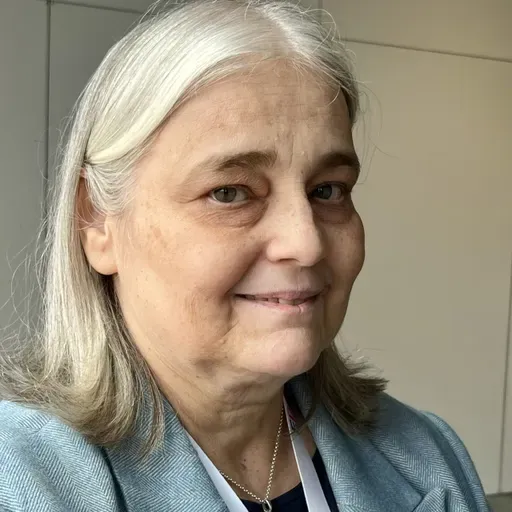
Fatima Cardoso MD; 2026 EBCC: OASIS-4 Trial Finds Elinzanetant Cuts Vasomotor Symptoms (“Hot Flashes”) in Endocrine Therapy-Treated Patients with Breast Cancer
Audio Journal of Oncology Podcast
OASIS-4 Trial Finds Elinzanetant Cuts Vasomotor Symptoms (“Hot Flashes”) in Endocrine Therapy-Treated Patients with Breast Cancer
An interview with:
Fatima Cardoso MD, Medical Oncologist, Head of Clinical Research & International Collaboration in Breast Cancer, Centre Antoine Lacassagne, Nice, France
BARCELONA, Spain—Vasomotor symptoms, or “hot flashes”, were greatly reduced in the OASIS-4 phase three placebo-controlled trial among patients receiving endocrine therapy for their breast cancers who were randomized to treatment with the dual neurokinin receptor antagonist elinzanetant. This was in data reported to the 2026 European Breast Cancer Conference by Professor Fatima Cardoso, a medical oncologist who is Head of Clinical Research and International Collaboration in Breast Cancer at the Centre Antoine Lacassagne in Nice, France. After talking at the conference she met up with the Audio Journal of Oncology’s reporter, Peter Goodwin:
AUDIO JOURNAL OF ONCOLOGY: Fatima Cardoso MD
IN: [GOODWIN]”I am here now with Fatima ….
OUT: …..Oncology, I’m Peter Goodwin 10:30
EBCC 2026 ABSTRACT
Abstract no: 3
Efficacy of elinzanetant for the treatment of vasomotor symptoms in women with breast cancer: subgroup analysis of the OASIS-4 trial by type of endocrine therapy
Cardoso1, D. Brennan2, T. Simoncini3, L. Wahyudi4, K. Laapas5, C. Seitz6,7
1Champalimaud Clinical Center/Champalimaud Foundation and ABC Global Alliance, Breast Unit, Lisbon, Portugal
2UCD School of Medicine, Mater Misericordiae University Hospital, Dublin, Ireland
3University of Pisa, Department of Clinical and Experimental Medicine, Pisa, Italy
4Bayer CC AG, Medical & Evidence CGT- OPH & WHC CH, Basel, Switzerland
5Bayer Oy, Development- Pharmaceuticals, Espoo, Finland
6Bayer AG, Clinical Development, Berlin, Germany
7Charité – Universitätsmedizin Berlin, Medical Faculty, Berlin, Germany
Background
In the Phase III trial OASIS-4 (NCT05587296), elinzanetant (EZN), a dual neurokinin (NK)-targeted therapy (NK1 and NK3 receptor antagonist), significantly reduced vasomotor symptom (VMS) frequency vs placebo (PBO) in women taking endocrine therapy (ET) for hormone receptor positive (HR+) breast cancer. This subgroup analysis evaluated EZN’s effects on VMS frequency and severity by type of ET in OASIS-4.
Materials and methods
Women aged 18–70 years experiencing ≥35 moderate-to-severe VMS/week caused by ET for HR+ breast cancer were randomized 2:1 to receive EZN 120 mg for 52 weeks or PBO for 12 weeks followed by EZN for 40 weeks. Mean changes from baseline in daily moderate-to-severe VMS frequency and severity to weeks 1 (frequency only), 4 and 12 were analyzed by ET type (tamoxifen [TAM], aromatase inhibitor [AI], ovarian function suppression [OFS; i.e., GnRH], no OFS). This post hoc analysis was not powered for statistical testing.
Results
Mean age (years) was 50.4 for TAM, 51.9 for AI, 45.2 for OFS and 53.4 for no OFS. At baseline, mean average daily moderate-to-severe VMS frequency ranged from 10.8-12.5 per day while VMS severity was 2.5 in all subgroups. Greater reductions in VMS frequency with EZN vs PBO were seen by week 1 across all subgroups (range EZN: -3.3 to -4.2; PBO: -1.6 to -2.1), with further reductions at week 4 (range EZN: -5.6 to -6.9; PBO: -2.5 to -3.7) and 12 (range EZN: -6.9 to -8.1; PBO: -3.0 to -5.8). A similar trend was observed for VMS severity at weeks 4 and 12 (Table). Reductions in VMS frequency and severity were maintained throughout the 52-week treatment period.
Conclusions
Consistent with results in the overall population, EZN had greater reductions in VMS frequency and severity than PBO with rapid onset and sustained effect over 52 weeks, irrespective of the type of ET.
Fatima Cardoso MD at EBCC 2026 A J Oncology March 28, 2026