07 July 2026
Take off your sunglasses: how light in your eyes secretly runs your hormones, sleep, and mood
Ancient Health Podcast
About
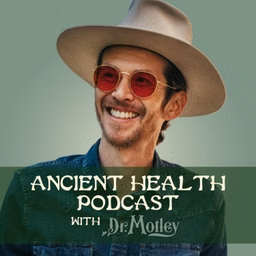
Should you be wearing sunglasses? We always thought the eyes just had one job: to see color and send pictures of our environment to our brains, but did you know that they also have a sensor that tells the brain when it’s time to get going for the day and when it’s time to sleep? That sensor can get disrupted when you head out with sunglasses on. In this episode, Dr. Motley weighs the pros and cons of sunglasses (at least in the morning!) by examining the science of light and circadian rhythms.
In this episode you'll learn:
How using sunglasses too frequently in the morning can throw our body’s natural clock out of whack and interfere with our sleep cycles.
How blue light in the morning (the natural kind you see in the sky) shuts off melatonin and activates cortisol by 50%, basically functioning as a cup of espresso for our bodies, and fake blue light at night confuses our sleep signals, suppressing melatonin within about 5 minutes.
How light regulates our hormones and acts as our body’s information center for when to start the day and when to get sleepy at night.
The effects of sunlight deficiency on our bodies and brains.
The difference between the kind of cortisol we need to help us function during the day and the kind that’s harmful.
Doctor Motley’s recommended full-day light protocol for resetting your internal clock. Get some light in your eyes within an hour of waking, and dim your lights at night.
In TCM, eye health is tied to the liver.
If you’re a sunglasses lover try to prioritize getting morning light into your eyes for 30 minutes (looking through a window may not really be enough, so head outside for a bit). Sunlight in the morning will help the rest of the day to go more smoothly.
Reading List:
The Organization of the Retina and Visual System: https://www.ncbi.nlm.nih.gov/books/NBK27326/
Transition from Dim Light to Sunlight in the Morning Raises Cortisol Immediately: https://doi.org/10.1210/jcem.86.1.7102
Evening Short-Term Exposure to Conventional Light Suppresses Melatonin and Increases Alertness Perception: 10.3390/ijms14022573
Awakening effects of blue-enriched morning light exposure on university students’ physiological and subjective responses: https://rdcu.be/fsqlH
These clock cells are most sensitive to short-wavelength blue light and drive non-image-forming responses https://rdcu.be/fsqnI
Eye Health from a Chinese Medicine Standpoint: https://www.herbalreality.com/condition/eye-health-chinese-medicine-perspective/
------
Want more of The Ancient Health Podcast? Subscribe to the YouTube channel.
Follow Doctor Motley
Instagram
Facebook
Website
------
*You can get cell support in gummy form: Mitopure is now offering a lower price to my community, when you go to timeline.com/DRMOTLEY.
*Join Doctor Motley’s newsletter for TCM insights and regular podcast updates: https://www.doctormotley.com/
*Do you have a ton more in-depth questions for Doctor Motley? Check out his course on emotions and the body in his membership. You’ll find other courses full of his expertise and clinical wisdom, plus bring all your questions to his weekly lives! To try risk-free for 15 days click here: https://www.doctormotley.com/15
In this episode you'll learn:
How using sunglasses too frequently in the morning can throw our body’s natural clock out of whack and interfere with our sleep cycles.
How blue light in the morning (the natural kind you see in the sky) shuts off melatonin and activates cortisol by 50%, basically functioning as a cup of espresso for our bodies, and fake blue light at night confuses our sleep signals, suppressing melatonin within about 5 minutes.
How light regulates our hormones and acts as our body’s information center for when to start the day and when to get sleepy at night.
The effects of sunlight deficiency on our bodies and brains.
The difference between the kind of cortisol we need to help us function during the day and the kind that’s harmful.
Doctor Motley’s recommended full-day light protocol for resetting your internal clock. Get some light in your eyes within an hour of waking, and dim your lights at night.
In TCM, eye health is tied to the liver.
If you’re a sunglasses lover try to prioritize getting morning light into your eyes for 30 minutes (looking through a window may not really be enough, so head outside for a bit). Sunlight in the morning will help the rest of the day to go more smoothly.
Reading List:
The Organization of the Retina and Visual System: https://www.ncbi.nlm.nih.gov/books/NBK27326/
Transition from Dim Light to Sunlight in the Morning Raises Cortisol Immediately: https://doi.org/10.1210/jcem.86.1.7102
Evening Short-Term Exposure to Conventional Light Suppresses Melatonin and Increases Alertness Perception: 10.3390/ijms14022573
Awakening effects of blue-enriched morning light exposure on university students’ physiological and subjective responses: https://rdcu.be/fsqlH
These clock cells are most sensitive to short-wavelength blue light and drive non-image-forming responses https://rdcu.be/fsqnI
Eye Health from a Chinese Medicine Standpoint: https://www.herbalreality.com/condition/eye-health-chinese-medicine-perspective/
------
Want more of The Ancient Health Podcast? Subscribe to the YouTube channel.
Follow Doctor Motley
Website
------
*You can get cell support in gummy form: Mitopure is now offering a lower price to my community, when you go to timeline.com/DRMOTLEY.
*Join Doctor Motley’s newsletter for TCM insights and regular podcast updates: https://www.doctormotley.com/
*Do you have a ton more in-depth questions for Doctor Motley? Check out his course on emotions and the body in his membership. You’ll find other courses full of his expertise and clinical wisdom, plus bring all your questions to his weekly lives! To try risk-free for 15 days click here: https://www.doctormotley.com/15