07 June 2026
UNSW's Quantum Cat Trick: How Gentler Measurements Hit 99.61% Accuracy and Why Error Correction Just Got Real
Advanced Quantum Deep Dives
About
This is your Advanced Quantum Deep Dives podcast.
They finally did it. In a quiet lab at UNSW Sydney, engineers just taught a quantum computer how not to scare Schrödinger’s cat.
I’m Leo, your Learning Enhanced Operator, and today on Advanced Quantum Deep Dives we’re unpacking my pick for the most interesting quantum paper of the week: the UNSW team’s new “don’t scare the cat” method for measuring qubits with far fewer errors. According to UNSW’s news release, they’ve found a way to check quantum information while disturbing it dramatically less, boosting the confidence of their readout to 99.61 percent.
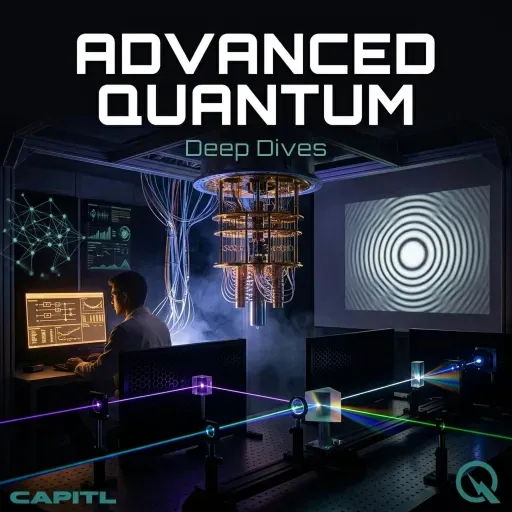
Picture the lab: steel dilution refrigerator towering like a silver tree, its gold-plated wiring descending into a darkness chilled just a fraction of a degree above absolute zero. Inside, an electron bound to a single atom becomes their “atomic cat.” In ordinary experiments, reading that cat’s state means repeatedly poking the system, each probe a little like yanking open box after box, hoping the cat doesn’t bolt.
The surprising fact in this work is how much they gain by changing the rhythm of those pokes. Using an adaptive strategy, they more than halve the chance of error and cut the total measurement time to about a third. Instead of hammering the qubit with uniform measurements, they stop as soon as they hear the first metaphorical “meow” and then selectively probe only where the cat is not supposed to be. It’s like debugging code by instantly skipping the lines that already passed their tests.
Why should you care while the headlines are dominated by classical AI deals and IPOs? As Datacenter Richness just highlighted, companies like Quantinuum are going public and tech giants are signing multibillion-dollar AI compute agreements. Classical data centers are ballooning into industrial cathedrals of silicon. But all of that AI power still runs on fragile assumptions about cryptography, chemistry, logistics. Utility-scale quantum machines will eventually be the strange new organs bolted onto those data centers, and they will live or die by one thing: error correction.
Quantum error correction is basically watchful paranoia: you encode one logical qubit into many physical ones, then constantly measure patterns that whisper, “an error just flipped here.” But those measurements themselves can destroy the quantum state if they’re too clumsy. That’s why the UNSW result matters. By extracting more information with less disturbance, their method could make mid-circuit measurements — the heartbeat of error correction — faster and cleaner across semiconductor, atomic, and even photonic platforms.
In a week when markets obsess over how many GPUs you can stuff into a warehouse, this paper quietly asks a deeper question: once we build our quantum cats, will we be wise enough not to scare them?
Thanks for listening. If you ever have any questions or have topics you want discussed on air, just send an email to leo@inceptionpoint.ai. Don’t forget to subscribe to Advanced Quantum Deep Dives. This has been a Quiet Please Production, and for more information you can check out quiet please dot AI.
For more http://www.quietplease.ai
Get the best deals https://amzn.to/3ODvOta
They finally did it. In a quiet lab at UNSW Sydney, engineers just taught a quantum computer how not to scare Schrödinger’s cat.
I’m Leo, your Learning Enhanced Operator, and today on Advanced Quantum Deep Dives we’re unpacking my pick for the most interesting quantum paper of the week: the UNSW team’s new “don’t scare the cat” method for measuring qubits with far fewer errors. According to UNSW’s news release, they’ve found a way to check quantum information while disturbing it dramatically less, boosting the confidence of their readout to 99.61 percent.
Picture the lab: steel dilution refrigerator towering like a silver tree, its gold-plated wiring descending into a darkness chilled just a fraction of a degree above absolute zero. Inside, an electron bound to a single atom becomes their “atomic cat.” In ordinary experiments, reading that cat’s state means repeatedly poking the system, each probe a little like yanking open box after box, hoping the cat doesn’t bolt.
The surprising fact in this work is how much they gain by changing the rhythm of those pokes. Using an adaptive strategy, they more than halve the chance of error and cut the total measurement time to about a third. Instead of hammering the qubit with uniform measurements, they stop as soon as they hear the first metaphorical “meow” and then selectively probe only where the cat is not supposed to be. It’s like debugging code by instantly skipping the lines that already passed their tests.
Why should you care while the headlines are dominated by classical AI deals and IPOs? As Datacenter Richness just highlighted, companies like Quantinuum are going public and tech giants are signing multibillion-dollar AI compute agreements. Classical data centers are ballooning into industrial cathedrals of silicon. But all of that AI power still runs on fragile assumptions about cryptography, chemistry, logistics. Utility-scale quantum machines will eventually be the strange new organs bolted onto those data centers, and they will live or die by one thing: error correction.
Quantum error correction is basically watchful paranoia: you encode one logical qubit into many physical ones, then constantly measure patterns that whisper, “an error just flipped here.” But those measurements themselves can destroy the quantum state if they’re too clumsy. That’s why the UNSW result matters. By extracting more information with less disturbance, their method could make mid-circuit measurements — the heartbeat of error correction — faster and cleaner across semiconductor, atomic, and even photonic platforms.
In a week when markets obsess over how many GPUs you can stuff into a warehouse, this paper quietly asks a deeper question: once we build our quantum cats, will we be wise enough not to scare them?
Thanks for listening. If you ever have any questions or have topics you want discussed on air, just send an email to leo@inceptionpoint.ai. Don’t forget to subscribe to Advanced Quantum Deep Dives. This has been a Quiet Please Production, and for more information you can check out quiet please dot AI.
For more http://www.quietplease.ai
Get the best deals https://amzn.to/3ODvOta