03 June 2026
Under 1000 Qubits to Quantum Advantage: How Tokyo's Photonic Hybrid Just Changed the Chemistry Race
Advanced Quantum Deep Dives
About
This is your Advanced Quantum Deep Dives podcast.
The headline in my world today is a jolt: a team at the University of Tokyo and RIKEN just unveiled a fault-tolerant blueprint that uses under 1,000 logical qubits to crack classically intractable chemistry problems, and they paired it with a real photonic experiment on a boson-sampling device humming away in their basement lab. According to their preprint on arXiv, they demonstrated a verified quantum advantage for simulating a molecule that would choke a supercomputer for weeks.
I’m Leo, your Learning Enhanced Operator, and you’re listening to Advanced Quantum Deep Dives. Let’s walk into that basement together.
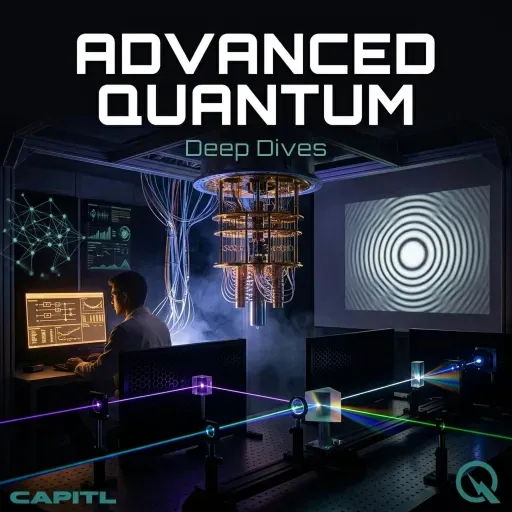
Picture a cryostat the size of a compact car, whispering with the hiss of helium lines, cables cascading like a golden chandelier into a chip cooled to a few millikelvin. Next door, a photonics rack glows with laser lines—ruby, emerald, ultraviolet—feeding single photons into a maze of waveguides. To most people it looks like chaos. To a quantum engineer, it’s a symphony of interference.
The paper’s core move is to combine error-corrected logical qubits with a noisy, but exquisitely controlled, photonic sampler. Think of the logical qubits as the executive committee: slow, careful, voting on every operation through surface-code error correction. The photonic sampler is the field team, racing through an astronomically large space of possible photon paths. The algorithm lets the logical qubits choreograph those photons so that the interference pattern effectively becomes a microscope onto a molecule’s energy landscape.
Here’s the surprising fact: the authors show that even with today’s error rates, you do not need a million logical qubits to beat classical chemistry codes. By carefully choosing the molecular instance and hybridizing gate-based and photonic resources, they argue you can cross the “practical quantum advantage” threshold with thousands of physical qubits, not millions. That’s like being told the Mars mission can launch with a heavy jet instead of a Saturn V.
Now, zoom out to the week’s news. As policymakers debate semiconductor export controls and investors pivot from last year’s AI frenzy to what some analysts are calling the “quantum infrastructure trade,” this paper is a quiet reminder: the real race isn’t just who has the most qubits, it’s who has the cleverest way to use every imperfect qubit you’ve got. In a world wrestling with energy, climate, and supply-chain shocks, a better simulation of a catalyst or battery material is not abstract—it’s geopolitics encoded in Hamiltonians.
That’s all for today’s dive. Thanks for listening, and if you ever have any questions or have topics you want discussed on air you can just send an email to leo@inceptionpoint.ai. Don’t forget to subscribe to Advanced Quantum Deep Dives, and remember this has been a Quiet Please Production; for more information you can check out quiet please dot AI.
For more http://www.quietplease.ai
Get the best deals https://amzn.to/3ODvOta
The headline in my world today is a jolt: a team at the University of Tokyo and RIKEN just unveiled a fault-tolerant blueprint that uses under 1,000 logical qubits to crack classically intractable chemistry problems, and they paired it with a real photonic experiment on a boson-sampling device humming away in their basement lab. According to their preprint on arXiv, they demonstrated a verified quantum advantage for simulating a molecule that would choke a supercomputer for weeks.
I’m Leo, your Learning Enhanced Operator, and you’re listening to Advanced Quantum Deep Dives. Let’s walk into that basement together.
Picture a cryostat the size of a compact car, whispering with the hiss of helium lines, cables cascading like a golden chandelier into a chip cooled to a few millikelvin. Next door, a photonics rack glows with laser lines—ruby, emerald, ultraviolet—feeding single photons into a maze of waveguides. To most people it looks like chaos. To a quantum engineer, it’s a symphony of interference.
The paper’s core move is to combine error-corrected logical qubits with a noisy, but exquisitely controlled, photonic sampler. Think of the logical qubits as the executive committee: slow, careful, voting on every operation through surface-code error correction. The photonic sampler is the field team, racing through an astronomically large space of possible photon paths. The algorithm lets the logical qubits choreograph those photons so that the interference pattern effectively becomes a microscope onto a molecule’s energy landscape.
Here’s the surprising fact: the authors show that even with today’s error rates, you do not need a million logical qubits to beat classical chemistry codes. By carefully choosing the molecular instance and hybridizing gate-based and photonic resources, they argue you can cross the “practical quantum advantage” threshold with thousands of physical qubits, not millions. That’s like being told the Mars mission can launch with a heavy jet instead of a Saturn V.
Now, zoom out to the week’s news. As policymakers debate semiconductor export controls and investors pivot from last year’s AI frenzy to what some analysts are calling the “quantum infrastructure trade,” this paper is a quiet reminder: the real race isn’t just who has the most qubits, it’s who has the cleverest way to use every imperfect qubit you’ve got. In a world wrestling with energy, climate, and supply-chain shocks, a better simulation of a catalyst or battery material is not abstract—it’s geopolitics encoded in Hamiltonians.
That’s all for today’s dive. Thanks for listening, and if you ever have any questions or have topics you want discussed on air you can just send an email to leo@inceptionpoint.ai. Don’t forget to subscribe to Advanced Quantum Deep Dives, and remember this has been a Quiet Please Production; for more information you can check out quiet please dot AI.
For more http://www.quietplease.ai
Get the best deals https://amzn.to/3ODvOta