12 June 2026
Quantum Advantage Unlocked: How Google's Chip Simulates Physics Beyond Classical Supercomputers
Advanced Quantum Deep Dives
About
This is your Advanced Quantum Deep Dives podcast.
You’re listening to Advanced Quantum Deep Dives, and I’m Leo – Learning Enhanced Operator. Let’s skip the pleasantries and jump straight into the wavefunction.
This morning, over espresso and calibration logs, I opened arXiv and saw what may be the most intriguing quantum paper of the week: a team from Google Quantum AI, Caltech, and the University of Innsbruck reporting a programmable experiment that appears to show genuine quantum advantage for simulating non‑equilibrium physics on a superconducting processor. Think of it as using qubits to watch a tiny universe evolve in fast‑forward, in a way no classical supercomputer can quite keep up with.
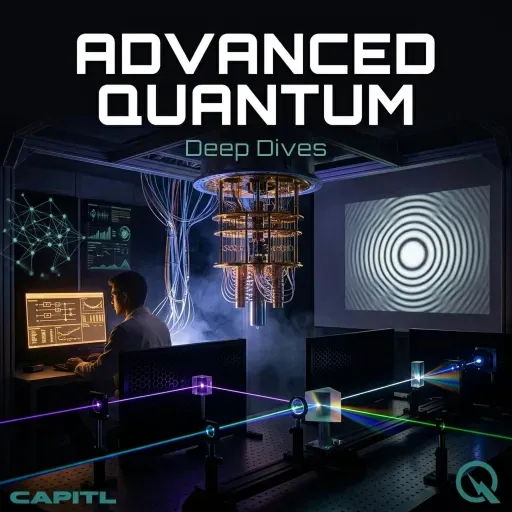
Picture the lab: a silver dilution refrigerator towering like a chrome stalactite, humming almost imperceptibly, cooling that chip down to a few millikelvin above absolute zero. Inside, qubits made from aluminum and niobium oscillate with a delicacy that makes a soap bubble look rugged. In the experiment, they encoded a lattice model – essentially a tiny crystal of artificial matter – then drove it far from equilibrium with precisely timed microwave pulses, capturing how correlations spread and entanglement blooms across the chip.
Here’s the surprising fact: the authors estimate that a faithful classical simulation of their full experiment would demand petabytes of memory and weeks of runtime on a top‑tier supercomputer, while the quantum device finishes in minutes. We’re not breaking cryptography yet, but for this very specific physics problem, the balance of power clearly tilts quantum.
As I read, my news feed flashed another headline: central banks debating how to regulate quantum‑resistant digital currencies, while cybersecurity firms model the day post‑quantum algorithms become mandatory. The contrast struck me. In Zurich and Washington, policymakers wrestle with inflation and digital asset rules. In Santa Barbara and Innsbruck, physicists wrestle with decoherence and two‑qubit gate fidelities. Yet it’s all the same story: uncertainty, risk, and correlation, whether in markets or in qubit arrays.
Entanglement in their experiment looks a lot like global supply chains: disturb one node, and the impact ripples everywhere, sometimes in beautifully predictable waves, sometimes chaotically. The difference is that on a quantum chip, we can write down the Hamiltonian, press run, and replay the universe. Out here in the macro world, we’re still guessing the rules.
For you, the non‑specialist but deeply curious listener, the key takeaway is this: quantum computing’s first killer apps may not be breaking Bitcoin or cracking your bank account, but acting as microscopes for reality itself – tools that let us probe materials, chemistry, and exotic phases of matter that standard computers can only approximate.
Thanks for listening. If you ever have any questions or have topics you want discussed on air, just send an email to leo@inceptionpoint.ai. Don’t forget to subscribe to Advanced Quantum Deep Dives. This has been a Quiet Please Production, and for more information you can check out quiet please dot AI.
For more http://www.quietplease.ai
Get the best deals https://amzn.to/3ODvOta
You’re listening to Advanced Quantum Deep Dives, and I’m Leo – Learning Enhanced Operator. Let’s skip the pleasantries and jump straight into the wavefunction.
This morning, over espresso and calibration logs, I opened arXiv and saw what may be the most intriguing quantum paper of the week: a team from Google Quantum AI, Caltech, and the University of Innsbruck reporting a programmable experiment that appears to show genuine quantum advantage for simulating non‑equilibrium physics on a superconducting processor. Think of it as using qubits to watch a tiny universe evolve in fast‑forward, in a way no classical supercomputer can quite keep up with.
Picture the lab: a silver dilution refrigerator towering like a chrome stalactite, humming almost imperceptibly, cooling that chip down to a few millikelvin above absolute zero. Inside, qubits made from aluminum and niobium oscillate with a delicacy that makes a soap bubble look rugged. In the experiment, they encoded a lattice model – essentially a tiny crystal of artificial matter – then drove it far from equilibrium with precisely timed microwave pulses, capturing how correlations spread and entanglement blooms across the chip.
Here’s the surprising fact: the authors estimate that a faithful classical simulation of their full experiment would demand petabytes of memory and weeks of runtime on a top‑tier supercomputer, while the quantum device finishes in minutes. We’re not breaking cryptography yet, but for this very specific physics problem, the balance of power clearly tilts quantum.
As I read, my news feed flashed another headline: central banks debating how to regulate quantum‑resistant digital currencies, while cybersecurity firms model the day post‑quantum algorithms become mandatory. The contrast struck me. In Zurich and Washington, policymakers wrestle with inflation and digital asset rules. In Santa Barbara and Innsbruck, physicists wrestle with decoherence and two‑qubit gate fidelities. Yet it’s all the same story: uncertainty, risk, and correlation, whether in markets or in qubit arrays.
Entanglement in their experiment looks a lot like global supply chains: disturb one node, and the impact ripples everywhere, sometimes in beautifully predictable waves, sometimes chaotically. The difference is that on a quantum chip, we can write down the Hamiltonian, press run, and replay the universe. Out here in the macro world, we’re still guessing the rules.
For you, the non‑specialist but deeply curious listener, the key takeaway is this: quantum computing’s first killer apps may not be breaking Bitcoin or cracking your bank account, but acting as microscopes for reality itself – tools that let us probe materials, chemistry, and exotic phases of matter that standard computers can only approximate.
Thanks for listening. If you ever have any questions or have topics you want discussed on air, just send an email to leo@inceptionpoint.ai. Don’t forget to subscribe to Advanced Quantum Deep Dives. This has been a Quiet Please Production, and for more information you can check out quiet please dot AI.
For more http://www.quietplease.ai
Get the best deals https://amzn.to/3ODvOta