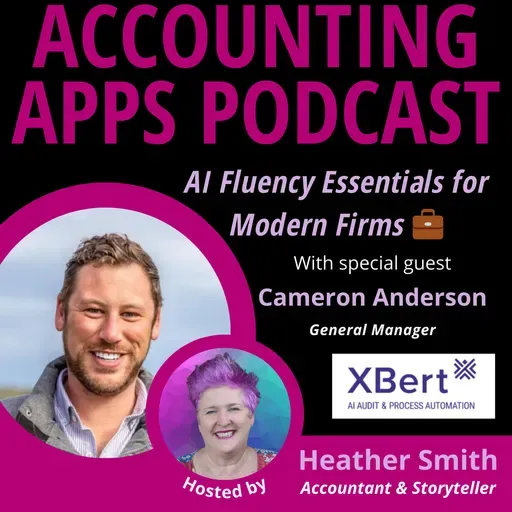
Cameron Anderson General Manager XBert
What does AI fluency really mean for accountants and bookkeepers? This episode explores governance, prompting frameworks, and practical AI use cases you can apply immediately.
Summary
In this episode, we explore AI fluency for accountants and bookkeepers and what it really means in practice. From governance to prompting frameworks, we unpack practical steps firms can take today.
Key Discussion Points
What AI fluency means for modern bookkeeping firms
Traditional AI vs Generative AI explained simply
The AI and human partnership model
Governance, ethics, and client disclosure considerations
The RTRI prompting framework: Role, Task, Requirements, Instructions
AI use cases across client communication, reporting, and operations
Using AI for financial analysis and contextual insights
Capacity planning and workflow intelligence
Starting small and building sustainable capability
Why data quality underpins every AI initiative
Key Takeaways
AI should augment human judgement, not replace it
Start with low risk, easy to validate use cases
Build AI capability alongside human skills
Transparency and governance matter
Small, consistent learning builds long term fluency
Apps & Tools Mentioned
XBert, Xero, ChatGPT, Gamma, Otter.ai, Fireflies.ai, Gmail, Microsoft Outlook
Contact details:
Cameron Anderson : https://www.linkedin.com/in/cameronanderson2/
XBert : https://www.xbert.io/
Accounting Apps newsletter: http://accountingapps.io/
Accounting Apps Mastermind: https://www.facebook.com/groups/XeroMasterMind
LinkedIn: https://www.linkedin.com/in/HeatherSmithAU/
YouTube Channel: https://www.youtube.com/ANISEConsulting
X: https://twitter.com/HeatherSmithAU