About
Readings Micah 6:1-8; 1 Corinthians 1:18-31; Matthew 5:1-12
Sermon God's kindness and our action
a. Kindness That Shapes Faith
i. Kindness at a Time of Transition
Just over 40 years ago aged 18 I went to O week at the University of Queensland for the beginning of my University studies. At the stalls put up to promote the clubs and societies of the University, I deliberately looked for one of the Christian clubs. I don't think I got much further than the first one. That was because the young man staffing the stall listened to me. He engaged me in genuine conversation. He took a real interest in me and what I was doing and where I had come from. He showed kindness.
This was a difficult time of transition for me. I was going from school to University. My Dad a Uniting Church minister Pete Gillies, had been forced to retire, very much against his will, on health grounds. So because I was shown kindness, by this young man it was that Christian group I joined.
It turned out to be a good choice. I found friendship and support and deepened my faith. I got through a time of difficult transition and I hung on at Uni.
ii. Kindness That Points Beyond Itself
But why had I sought out a Christian group at Uni at all? I could have gone to the Rec Club and got drunk. I could have joined the chocolate appreciation society or one of the political groups. I sought out one of the Christian clubs, because through my life, a lot of people had shown me mercy or kindness, setting an example, and teaching me faith. For instance, mum who nurtured me in life and faith, my Dad who set an example of standing up for justice, Sunday school teachers and friends from church who encouraged me and stood by me.I was bullied at school but my friends at church were somehow different. By the work of the Spirit I was able to look beyond these people who showed me kindness to the one they served. Their lives pointed me to Jesus.
iii. Kindness That Leads to Action
So I came to faith, to trust in Jesus, and having faith I was led to worship God, to serve and love my neighbours, and to witness my faith to others. I was led to action.
b. The Big Biblical Story of God's Kindness
i. A God Who Rescues the Broken
What has this got to do with any of our readings. Well to understand the Beatitudes and Micah 6:8 I think we have to understand the big biblical story of the kindness and mercy of God.
The story of salvation is of God showing kindness or mercy or grace, to broken people, broken nations, and our whole broken world. It is the story of God turning people from enemies into friends. In the Old Testament the people of Israel are rescued, released from slavery in Egypt where they are slaves made to labour, in fear of the lash and regarded as property by their oppressors. God sees their suffering and comes down to rescue them, calling Moses to be their leader and delivering them to a promised land of plenty.
ii. Faithless People, Faithful God
Time and time again they wander away, they are ungrateful to God, but even though they rebel and lose faith, God remains faithful to them. It is to a similar time of darkness and of wandering away that Micah speaks the words of God.
During Micah's life the Jewish people in the north are defeated and taken into exile by the by the Assyrian Empire and those in the south around Jerusalem fear the same thing. They have turned back to God in their words and their worship, but not in their actions. Micah reminds them that being one of God's people is more than singing the right songs, sacrificing animals, and giving money to the church (or temple).
Micah reminds them of God's kindness or mercy of the past. He reminds them of how they were rescued from slavery and given a place to call their own.
Verse 4 "I brought you out of Egypt; I rescued you from slavery; I sent Moses, Aaron, and Miriam to lead you." (Micah 6:4, TEV) We read Micah 6:8 ("So what does the Lord require of you ...Justice, ...mercy & ...faithfulness"), in this light.
iii. Micah's Invitation, Not a Threat
God has rescued you, God loves you, God has brought you out of slavery. God has made you a people who were no people, the people of God, the family of God. Not be good or else! or be good or you won't go to heaven, or God won't love you. But be good because God already loves you, and has saved you. So what does the LORD want from us? "The LORD God has told us what is right and what he demands: "See that justice is done, let mercy be your first concern, and humbly obey your God."" (Micah 6:8, CEV)
This is God's commandment but it is also an invitation. Just as I accepted the invitation to join the Christian group at university because of kindness, just as I came to trust in Jesus because of kindness of those around me, and because of them discovered the kindness of Jesus himself, so we the people of God are invited to action because of the kindness God has already shown us.
c. Paul and the Cross Before Change
This is the same point Paul is making in 1 Corinthians. As with Micah and the Jewish people, Paul was writing to the people of God in a mess. Like the people of Micah's time, they had great worship. Speaking in tongues, healings, prophecy, but they were bitterly divided. So Paul points this out: You're divided. It is wrong! You should be all united in Christ. But next he doesn't tell them how to do better so God will love them. Instead he reminds them of God's kindness in Jesus and the cross.
i. Christ Crucified: The Shape of God's Wisdom
He says this "Jews want miracles for proof, and Greeks look for wisdom. As for us, we proclaim the crucified Christ, a message that is offensive to the Jews and nonsense to the Gentiles; but for those whom God has called, both Jews and Gentiles, this message is Christ, who is the power of God and the wisdom of God." (1 Corinthians 1:22–24, TEV)
"... God has brought you into union with Christ Jesus, and God has made Christ to be our wisdom. By him we are put right with God; we become God's holy people and are set free." (1 Corinthians 1:30, TEV)
Only then having reminded them of the gift of God's love in Jesus does he go on to talk about the divisions among them and how they should behave. God's kindness, mercy, restoring and rescuing love come first.
d. The Kindness of God as an Invitation to Live
i. The Kingdom Has Come Near
The same pattern of God's love and mercy and saving power coming first is also in the Gospel of Matthew. The Sermon on the Mount chapters 5-7 of the book of Matthew should not be read without remembering what is in the second half of chapter 4. And I just want to pick one verse from there. Jesus begins his his preaching, his public work, by saying Repent, a call to action, but why, in what context? "Repent for the Kingdom of Heaven has come near."
Repent means to turn to God, to love God and all the neighbours God gives you and stop being selfish and self centred. So turn to God, not so God will love you, not to become rich, or to be self fulfilled or happy. Turn to God because the Kingdom of Heaven has come near. What does this mean. It means that God has come near, heaven and earth are coming together. We see a picture of this in our reading today but we also see it at the very end of chapter 4, the words just before today's reading.
"Jesus went all over Galilee, teaching in the synagogues, preaching the Good News about the Kingdom, and healing people who had all kinds of disease and sickness." (Matthew 4:23, TEV)
God, (heaven) had come near in Jesus, people heard and saw God's love in the teaching and the healing and the friendship of Jesus. A friendship shown not to the great and the wise and the Mighty but to the weak, the sinful, the broken and the divided. And this kindness of God would extend not only to teaching and healing, but even to death by exposure in public shame. Jesus nailed to a wooden cross. And this kindness of God also would even extend to the grave. The grave is empty for he has been raised from the dead. For the Kingdom of heaven has come near. God's kindness comes first and because of that I and I'm guessing you came to trust in Jesus.
ii. Hearing the Beatitudes as Invitation
When you hear the Sermon on the Mount, do you fall short? Are you always poor in spirit? Are you always meek? Do you always hunger and thirst for righteousness? Have you ever been persecuted for being a faithful Christian? Are you always pure in heart? Are you always a peacemaker?
I know that you are not, and I know that I am not always those things.
But do not hear these words of Jesus as condemnation of you and do not hear them as words of condemnation of others. Instead hear these words of Jesus as an invitation, because God's kindness always comes first. Yes we all need to do better, and we have all fallen short, but the kindness of God, the Kingdom of Heaven, Jesus who calls sinners like you and me is already ours. And it is this same Jesus who heals the broken and in the Spirit's power turns death to life who invites us to action. Invites us to live as though heaven and earth were already combined. In him they already are combined. So I appeal to you as Paul did in Romans 12:1 by the mercy, the kindness of God, to hear these words as an invitation from the one "who loved us and gave us life."
iii. Reflecting Heaven on Earth
So if you are willing, close your eyes and imagine Jesus speaking these words. Jesus who heals the sick and loves the sinner. He invites you to reflect a little bit of heaven here on earth as he says:
""God blesses those who are poor and realize their need for him,
for the Kingdom of Heaven is theirs.
God blesses those who mourn, for they will be comforted.
God blesses those who are humble,
for they will inherit the whole earth.
God blesses those who hunger and thirst for justice,
for they will be satisfied.
God blesses those who are merciful,
for they will be shown mercy.
God blesses those whose hearts are pure, for they will see God.
God blesses those who work for peace,
for they will be called the children of God." (Matthew 5:3–9, NLT)
Amen
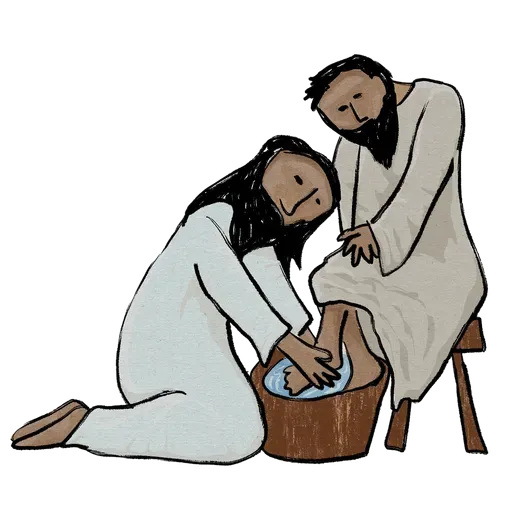
Image by Deborah Radeka from Pixabay