The Book of Changes (Traditional: 易經; Simplified: 易经; Legge: Yî King, Wade-Giles: I Ching; Pīnyīn: Yìjīng; Bopomofo: ㄧˋㄐㄧㄥ; Korean: 역경; Japanese: 易経; Vietnamese: Kinh Dịch)
Fúxī (伏羲), King Tāng of Shāng (商湯), King Wén of Zhōu (周文王), his son the Duke of Zhōu (周公旦), and Confucius (孔子) have traditionally been credited as the originators of the trigrams (八卦 bāguà), hexagrams (卦 guà), hexagram statements (彖 tuàn), line statements (爻辭 yáocí), and Ten Wings (十翼) commentaries.
"The I Ching does not offer itself with proofs and results; it does not vaunt itself, nor is it easy to approach. Like a part of nature, it waits until it is discovered." — Carl Jung
Different combinations of three yang (⚊) and yin (⚋) lines create the eight trigrams, namely:
☰ (乾 Qián Heaven, the sky. S. Untiring strength; power.) or (Father. NW)
☱ (兌 Duì Lake, or marsh. Collected water. SE. Pleasure; complacent satisfaction.) or (Youngest daughter. W)
☲ (離 Lí Fire, as in lightning; the sun. E. Brightness; elegance.) or (Second daughter. S)
☳ (震 Zhèn Thunder. NE. Moving, exciting power.) or (Oldest son. E)
☴ (巽 Xùn Wind; wood. SW. Flexibility; penetration.) or (Oldest daughter. SE)
☵ (坎 Kǎn Water, as in rain, clouds, springs, streams, and defiles. The moon. NW. Peril; difficulty.) or (Second son. N)
☶ (艮 Gèn Hills, or mountains. NW. Resting; the act of arresting.) or (Youngest son. NE)
☷ (坤 Kūn The Earth. N. Capaciousness; submission.) or (Mother. SW)
When three lines are added to a trigram the resultant pairs of trigrams constitute the sixty-four hexagrams. The lower trigram is called 'the inner,' and the one above 'the outer.' The lines are numbered from one to six, commencing with the lowest. To denote the number of it and of the sixth line, the terms for 'commencing' and 'topmost' are used. The intermediate lines are simply 'second,' 'third,' &c. As the lines must be either whole or divided, technically called strong and weak, yang and yin, this distinction is indicated by the application to them of the numbers nine and six. All whole lines are nine, all divided lines, six.
The Book of Changes is included as one of the Five Classics (五經) of the Confucian canon and Confucius said, "If some years were added to my life, I would give fifty to the study of the Yì, and might then escape falling into great errors." (Analects, VII.16)
Scottish translator James Legge was a Hong Kong missionary, Non-Conformist Pastor of the English Union Church, and the first professor of Chinese studies at Oxford University. The original manuscript of his translation was nearly destroyed after being soaked in the Red Sea for a month.
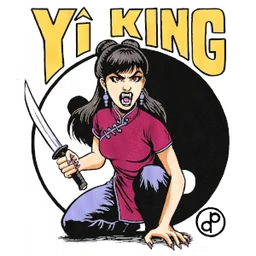
Cover: Leftmost Guardian of the Yî by cartoonist Robin Bougie (2024), released by him into the public domain.
Special thanks to Lancy (王欣兰), a graduate student at Guangdong University of Foreign Studies, for her help with Chinese pronunciation.
Fúxī (伏羲), King Tāng of Shāng (商湯), King Wén of Zhōu (周文王), his son the Duke of Zhōu (周公旦), and Confucius (孔子) have traditionally been credited as the originators of the trigrams (八卦 bāguà), hexagrams (卦 guà), hexagram statements (彖 tuàn), line statements (爻辭 yáocí), and Ten Wings (十翼) commentaries.
"The I Ching does not offer itself with proofs and results; it does not vaunt itself, nor is it easy to approach. Like a part of nature, it waits until it is discovered." — Carl Jung
Different combinations of three yang (⚊) and yin (⚋) lines create the eight trigrams, namely:
☰ (乾 Qián Heaven, the sky. S. Untiring strength; power.) or (Father. NW)
☱ (兌 Duì Lake, or marsh. Collected water. SE. Pleasure; complacent satisfaction.) or (Youngest daughter. W)
☲ (離 Lí Fire, as in lightning; the sun. E. Brightness; elegance.) or (Second daughter. S)
☳ (震 Zhèn Thunder. NE. Moving, exciting power.) or (Oldest son. E)
☴ (巽 Xùn Wind; wood. SW. Flexibility; penetration.) or (Oldest daughter. SE)
☵ (坎 Kǎn Water, as in rain, clouds, springs, streams, and defiles. The moon. NW. Peril; difficulty.) or (Second son. N)
☶ (艮 Gèn Hills, or mountains. NW. Resting; the act of arresting.) or (Youngest son. NE)
☷ (坤 Kūn The Earth. N. Capaciousness; submission.) or (Mother. SW)
When three lines are added to a trigram the resultant pairs of trigrams constitute the sixty-four hexagrams. The lower trigram is called 'the inner,' and the one above 'the outer.' The lines are numbered from one to six, commencing with the lowest. To denote the number of it and of the sixth line, the terms for 'commencing' and 'topmost' are used. The intermediate lines are simply 'second,' 'third,' &c. As the lines must be either whole or divided, technically called strong and weak, yang and yin, this distinction is indicated by the application to them of the numbers nine and six. All whole lines are nine, all divided lines, six.
The Book of Changes is included as one of the Five Classics (五經) of the Confucian canon and Confucius said, "If some years were added to my life, I would give fifty to the study of the Yì, and might then escape falling into great errors." (Analects, VII.16)
Scottish translator James Legge was a Hong Kong missionary, Non-Conformist Pastor of the English Union Church, and the first professor of Chinese studies at Oxford University. The original manuscript of his translation was nearly destroyed after being soaked in the Red Sea for a month.
Cover: Leftmost Guardian of the Yî by cartoonist Robin Bougie (2024), released by him into the public domain.
Special thanks to Lancy (王欣兰), a graduate student at Guangdong University of Foreign Studies, for her help with Chinese pronunciation.
LibriVox recordings are public domain in the United States; copyright status may differ elsewhere.
Chapters
- Chapter 1
Hexagram 01 ䷀ 乾 Qián
12:57 - Chapter 2
Hexagram 02 ䷁ 坤 Kūn
08:53 - Chapter 3
Hexagram 03 ䷂ 屯 Zhūn
07:10 - Chapter 4
Hexagram 04 ䷃ 蒙 Méng
07:30 - Chapter 5
Hexagram 05 ䷄ 需 Xū
06:43 - Chapter 6
Hexagram 06 ䷅ 訟 Sòng
06:56 - Chapter 7
Hexagram 07 ䷆ 師 Shī
06:13 - Chapter 8
Hexagram 08 ䷇ 比 Bǐ
07:01 - Chapter 9
Hexagram 09 ䷈ 小畜 Xiǎo Xù
06:44 - Chapter 10
Hexagram 10 ䷉ 履 Lǚ
06:24 - Chapter 11
Hexagram 11 ䷊ 泰 Tài
07:07 - Chapter 12
Hexagram 12 ䷋ 否 Pǐ
06:59 - Chapter 13
Hexagram 13 ䷌ 同人 Tóng Rén
06:10 - Chapter 14
Hexagram 14 ䷍ 大有 Dà Yǒu
05:41 - Chapter 15
Hexagram 15 ䷎ 謙 Qiān
06:13 - Chapter 16
Hexagram 16 ䷏ 豫 Yù
06:58 - Chapter 17
Hexagram 17 ䷐ 隨 Suí
05:39 - Chapter 18
Hexagram 18 ䷑ 蠱 Gǔ
06:07 - Chapter 19
Hexagram 19 ䷒ 臨 Lín
05:49 - Chapter 20
Hexagram 20 ䷓ 觀 Guān
05:40 - Chapter 21
Hexagram 21 ䷔ 噬嗑 Shì Hé
05:59 - Chapter 22
Hexagram 22 ䷕ 賁 Bì
06:39 - Chapter 23
Hexagram 23 ䷖ 剝 Bō
05:58 - Chapter 24
Hexagram 24 ䷗ 復 Fù
06:06 - Chapter 25
Hexagram 25 ䷘ 無妄 Wú Wàng
05:51 - Chapter 26
Hexagram 26 ䷙ 大畜 Dà Xù
06:27 - Chapter 27
Hexagram 27 ䷚ 頤 Yí
06:12 - Chapter 28
Hexagram 28 ䷛ 大過 Dà Guò
06:14 - Chapter 29
Hexagram 29 ䷜ 坎 Kǎn
06:56 - Chapter 30
Hexagram 30 ䷝ 離 Lí
05:13 - Chapter 31
Hexagram 31 ䷞ 咸 Xián
06:36 - Chapter 32
Hexagram 32 ䷟ 恆 Héng
06:37 - Chapter 33
Hexagram 33 ䷠ 遯 Dùn
06:03 - Chapter 34
Hexagram 34 ䷡ 大壯 Dà Zhuàng
05:46 - Chapter 35
Hexagram 35 ䷢ 晉 Jìn
05:58 - Chapter 36
Hexagram 36 ䷣ 明夷 Míng Yí
06:19 - Chapter 37
Hexagram 37 ䷤ 家人 Jiā Rén
06:18 - Chapter 38
Hexagram 38 ䷥ 睽 Kuí
07:13 - Chapter 39
Hexagram 39 ䷦ 蹇 Jiǎn
06:30 - Chapter 40
Hexagram 40 ䷧ 解 Xiè
07:24 - Chapter 41
Hexagram 41 ䷨ 損 Sǔn
07:15 - Chapter 42
Hexagram 42 ䷩ 益 Yì
07:22 - Chapter 43
Hexagram 43 ䷪ 夬 Guài
07:51 - Chapter 44
Hexagram 44 ䷫ 姤 Gòu
06:13 - Chapter 45
Hexagram 45 ䷬ 萃 Cuì
07:11 - Chapter 46
Hexagram 46 ䷭ 升 Shēng
05:32 - Chapter 47
Hexagram 47 ䷮ 困 Kùn
07:31 - Chapter 48
Hexagram 48 ䷯ 井 Jǐng
06:29 - Chapter 49
Hexagram 49 ䷰ 革 Gé
07:03 - Chapter 50
Hexagram 50 ䷱ 鼎 Dǐng
06:34 - Chapter 51
Hexagram 51 ䷲ 震 Zhèn
08:03 - Chapter 52
Hexagram 52 ䷳ 艮 Gèn
05:14 - Chapter 53
Hexagram 53 ䷴ 漸 Jiàn
07:14 - Chapter 54
Hexagram 54 ䷵ 歸妹 Guī Mèi
06:37 - Chapter 55
Hexagram 55 ䷶ 豐 Fēng
07:59 - Chapter 56
Hexagram 56 ䷷ 旅 Lǚ
06:09 - Chapter 57
Hexagram 57 ䷸ 巽 Xùn
06:24 - Chapter 58
Hexagram 58 ䷹ 兌 Duì
05:34 - Chapter 59
Hexagram 59 ䷺ 渙 Huàn
05:41 - Chapter 60
Hexagram 60 ䷻ 節 Jié
06:04 - Chapter 61
Hexagram 61 ䷼ 中孚 Zhōng Fú
06:39 - Chapter 62
Hexagram 62 ䷽ 小過 Xiǎo Guò
07:47 - Chapter 63
Hexagram 63 ䷾ 既濟 Jì Jì
05:31 - Chapter 64
Hexagram 64 ䷿ 未濟 Wèi Jì
06:34 - Chapter 65
The Great Appendix 大傳 - Section 1
56:02 - Chapter 66
The Great Appendix 大傳 - Section 2
50:27 - Chapter 67
Commentary on the Words 文言傳
27:02 - Chapter 68
Remarks on the Trigrams 說卦傳
23:00 - Chapter 69
The Orderly Sequence of the Hexagrams 序卦傳
20:45 - Chapter 70
Treatise on the Hexagrams Taken Promiscuously 雜卦傳
06:27