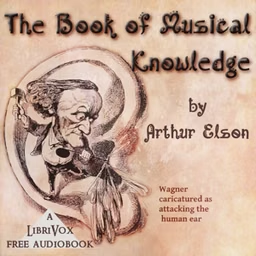
This book has been planned with a view to placing before the general reader the main facts that will enable him to appreciate music intelligently. One often hears the remark, "I’m fond of music, but I don’t understand it." The present work has been written with the idea of enabling the non-musician to comprehend the real meaning of the tonal art, and to familiarize himself with the value of the great composers’ works, the use of the instruments, the various musical forms, and a number of subjects of similar importance.
At the same time, certain other technical topics have been included. While these have been presented in such a way as to be understood by the non-musician, they have been given with sufficient thoroughness to make the work useful also as a textbook. It is therefore fitted to the needs of students and teachers, as well as amateurs. An effort has been made to condense the chief points of a general musical education into a single volume. While this book should prove of interest to the average reader, a course of study has been added, which will make it suitable for use in high schools or colleges also, or in any institution that aims to give a course in the understanding of music. - Summary by Preface
NOTE: As with all historical texts, the language used in this volume should be interpreted within the context of the entire work and the cultural context of its publication.
At the same time, certain other technical topics have been included. While these have been presented in such a way as to be understood by the non-musician, they have been given with sufficient thoroughness to make the work useful also as a textbook. It is therefore fitted to the needs of students and teachers, as well as amateurs. An effort has been made to condense the chief points of a general musical education into a single volume. While this book should prove of interest to the average reader, a course of study has been added, which will make it suitable for use in high schools or colleges also, or in any institution that aims to give a course in the understanding of music. - Summary by Preface
NOTE: As with all historical texts, the language used in this volume should be interpreted within the context of the entire work and the cultural context of its publication.
LibriVox recordings are public domain in the United States; copyright status may differ elsewhere.
Chapters
- Chapter 1
Primitive and Savage Music
23:52 - Chapter 2
Greece and Rome
24:51 - Chapter 3
Early Christian Music
19:36 - Chapter 4
The Minstrel Knights
23:11 - Chapter 5
The Schools of Counterpoint
31:08 - Chapter 6
The Harmonic Style
19:40 - Chapter 7
Bach
25:54 - Chapter 8
Handel
18:03 - Chapter 9
Gluck
15:59 - Chapter 10
Haydn
17:19 - Chapter 11
Mozart
23:55 - Chapter 12
Beethoven
32:58 - Chapter 13
Schubert
22:16 - Chapter 14
Weber and Romanticism
17:09 - Chapter 15
Mendelssohn
19:50 - Chapter 16
Schumann
20:55 - Chapter 17
Chopin
22:00 - Chapter 18
Italian Opera
32:15 - Chapter 19
Cherubini and French Opera
23:38 - Chapter 20
Berlioz and Other Frenchmen
22:37 - Chapter 21
Liszt and his Circle
24:49 - Chapter 22
From Glinka to Tschaikovsky
29:00 - Chapter 23
Wagner and his Reforms
36:11 - Chapter 24
Brahms and the Symphonists
23:19 - Chapter 25
Grieg and the Northern Countries
22:57 - Chapter 26
Strauss and Recent Germans
35:48 - Chapter 27
Franck and Modern France
27:40 - Chapter 28
The Russian School
26:01 - Chapter 29
Other European Nations
53:39 - Chapter 30
America
44:55 - Chapter 31
Melody and Appreciation
20:06 - Chapter 32
Figures and Phrases
19:02 - Chapter 33
The Song-Forms
16:09 - Chapter 34
The Rondos
12:57 - Chapter 35
The Sonata-Allegro Form
14:36 - Chapter 36
Other Sonata Movements
11:17 - Chapter 37
The Orchestral Forms
12:05 - Chapter 38
Dances and Piano Styles
24:04 - Chapter 39
The Vocal Forms
14:47 - Chapter 40
The Contrapunctual Forms
24:22 - Chapter 41
The Piano and its Predecessors
20:04 - Chapter 42
The Organ
19:17 - Chapter 43
The Voice
19:13 - Chapter 44
The Violin
21:55 - Chapter 45
Other Bowed Instruments
17:04 - Chapter 46
Pluck-String Instruments
16:02 - Chapter 47
Flute and Piccolo
17:08 - Chapter 48
Oboe and English Horn
16:23 - Chapter 49
The Bassoons
14:11 - Chapter 50
The Clarinets
13:25 - Chapter 51
Horns, Trumpets and Cornets
15:46 - Chapter 52
Trombones and Tubas
11:46 - Chapter 53
Instruments of Percussion
15:55 - Chapter 54
Some Famous Pianists
24:53 - Chapter 55
Some Famous Singers
24:29 - Chapter 56
Violinists and Violin Music
18:14 - Chapter 57
Orchestration
11:59 - Chapter 58
Conducting
16:23 - Chapter 59
Acoustics
36:08 - Chapter 60
How to Read Music Part 1
1:00:44 - Chapter 61
How to Read Music Part 2
20:56 - Chapter 62
Appendix: Important Music Terms
39:38