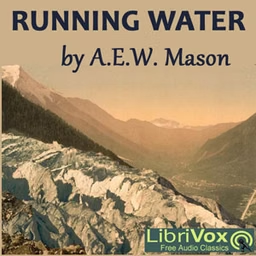
Although A.E.W. Mason is best known for The Four Feathers, an adventure novel of 1902 set in Egypt and the Sudan (and filmed several times), he was a prolific and popular writer of the period. Running Water, published in 1907, is, like its predecessor, a tale of romantic adventure. Though much of the story takes place in England, the real setting here is in the high Alps, in the range of Mont Blanc near Chamonix and Courmayeur. Here it is that Captain Hilary Chayne arrives, having spent the prior four years of his army service on the shores of the Red Sea, dreaming all the time of his return to the Alps, to the world of rock, ice, and snow, to mountaineering with all its challenges and joys, and to its comradeship. And here it is too that he meets the young and beautiful Sylvia Thesiger, a girl already in love with the high mountains, and seeking in them an escape, as far as possible, from her unpleasant and domineering mother.
Is it necessary to add that disappointments. problems, misunderstandings, and outright villainies, ensue to complicate the course of true love? After the twists and turns of novel's English midsection, the setting shifts back to the high Alps, and the final, climactic scene is played out on the heights of the Italian face of the Mont Blanc. This is the Brenva -- where thousands of feet of rock and glacier sweep steeply up to reach the highest point in western Europe. It is an Alpine route that today, over century later, even experienced climbers still find a challenge.
There are not many novels given over to mountaineering, and some consider Mason's descriptions of climbing among the finest in fiction. Unlike The Four Feathers, Running Water has never been filmed – though given the quality of some of Hollywood's mountaineering movies, that may actually be a blessing.
Finally, for those unfamiliar with the teminology, several French terms are customarily used by alpinists and appear in Mason's book. An aiguille (needle) is a peak, usually sharp pointed, often of rock, sometimes of ice and snow. The Chamonix aiguilles, many of which are mentioned here, are famous among climbers and lovers of alpine scenery. A col is a pass between two mountains, or ranges, and in the High Alps often of steep ice and snow, sometimes of rock. And an arête is a ridge, or spur, of a mountain, sometimes of ice or snow, sometimes of rock, and often of all three.
Historical note: The first ascent of the Brenva face was made by A.W. Moore and a party of three other British climbers and two Swiss alpine guides, in July, 1865. The account was published in Moore's book, The Alps in 1864, and it is this book that Garratt Skinner is reading in Chapter XII, as he lies in his Dorsetshire hammock. In 1943, another great British climber, T. Graham Brown published his Brenva, describing the various routes on the great southern face, on two of which had had made first ascents. Brown credits Running Water as first turning his attention to the face, and has high praise for its descriptions of mountaineering. (The second ascent for the Brenva route was made by W.A.P. Coolidge and others in 1870).
A further note: in Chapter XIII, Mason twice refers to Switzerland when he means France. Perhaps he was dozing; or perhaps he was drawing some of his material from Baedeker's Guide to Switzerland, whose earlier editions included the range of Mont Blanc, a chain shared by France, Italy, and Switzerland.
Is it necessary to add that disappointments. problems, misunderstandings, and outright villainies, ensue to complicate the course of true love? After the twists and turns of novel's English midsection, the setting shifts back to the high Alps, and the final, climactic scene is played out on the heights of the Italian face of the Mont Blanc. This is the Brenva -- where thousands of feet of rock and glacier sweep steeply up to reach the highest point in western Europe. It is an Alpine route that today, over century later, even experienced climbers still find a challenge.
There are not many novels given over to mountaineering, and some consider Mason's descriptions of climbing among the finest in fiction. Unlike The Four Feathers, Running Water has never been filmed – though given the quality of some of Hollywood's mountaineering movies, that may actually be a blessing.
Finally, for those unfamiliar with the teminology, several French terms are customarily used by alpinists and appear in Mason's book. An aiguille (needle) is a peak, usually sharp pointed, often of rock, sometimes of ice and snow. The Chamonix aiguilles, many of which are mentioned here, are famous among climbers and lovers of alpine scenery. A col is a pass between two mountains, or ranges, and in the High Alps often of steep ice and snow, sometimes of rock. And an arête is a ridge, or spur, of a mountain, sometimes of ice or snow, sometimes of rock, and often of all three.
Historical note: The first ascent of the Brenva face was made by A.W. Moore and a party of three other British climbers and two Swiss alpine guides, in July, 1865. The account was published in Moore's book, The Alps in 1864, and it is this book that Garratt Skinner is reading in Chapter XII, as he lies in his Dorsetshire hammock. In 1943, another great British climber, T. Graham Brown published his Brenva, describing the various routes on the great southern face, on two of which had had made first ascents. Brown credits Running Water as first turning his attention to the face, and has high praise for its descriptions of mountaineering. (The second ascent for the Brenva route was made by W.A.P. Coolidge and others in 1870).
A further note: in Chapter XIII, Mason twice refers to Switzerland when he means France. Perhaps he was dozing; or perhaps he was drawing some of his material from Baedeker's Guide to Switzerland, whose earlier editions included the range of Mont Blanc, a chain shared by France, Italy, and Switzerland.
LibriVox recordings are public domain in the United States; copyright status may differ elsewhere.
Chapters
- Chapter 1
01 - Shows Mrs. Thesiger in Her Home
16:00 - Chapter 2
02 - Introduces one of Strood\'s Successors
21:00 - Chapter 3
03 - The Finding of John Lattery
19:30 - Chapter 4
04 - Mr. Jarvice
16:09 - Chapter 5
05 - Michel Revailloud Expounds His Philosophy
20:20 - Chapter 6
06 - The Pavillon de Lognan
17:27 - Chapter 7
07 - The Aiguille de l\'Argentière
25:55 - Chapter 8
08 - Sylvia Parts From Her Mother
15:50 - Chapter 9
09 - Sylvia Makes the Acquaintance of Her Father
21:46 - Chapter 10
10 - A Little Round Game of Cards
17:07 - Chapter 11
11 - Sylvia\'s Father Makes a Mistake
17:59 - Chapter 12
12 - The House of the Running Water
24:20 - Chapter 13
13 - Chayne Returns
20:50 - Chapter 14
14 - An Old Passion Betrays a New Secret
17:23 - Chapter 15
15 - Kenyon\'s John Lattery
18:00 - Chapter 16
16 - As Between Gentlemen
20:13 - Chapter 17
17 - Sylvia Tells More Than She Knows
20:45 - Chapter 18
18 - Both Sides of the Question
16:54 - Chapter 19
19 - The Shadow in the Room
13:11 - Chapter 20
20 - On the Down
18:13 - Chapter 21
21 - Chayne Comes to Conclusions
30:28 - Chapter 22
22 - Revailloud Revisited
16:11 - Chapter 23
23 - Michel Revailloud\'s Führbuch
22:42 - Chapter 24
24 - The Brenva Ridge
26:08 - Chapter 25
25 - A Night on an Ice-Slope
23:46 - Chapter 26
26 - Running Water
19:31