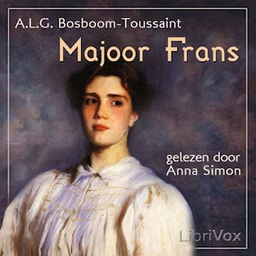
Een arme jonker, Leopold, wordt onverwacht een grote erfenis in het vooruitzicht gesteld na de dood van een oud-tante – onder één voorwaarde: hij moet met een nichtje van haar trouwen. Deze jonge vrouw, die Francis heet, is opgegroeid onder de hoede van haar grootvader, een generaal in het leger. Ze heeft een onconventionele opvoeding gehad die haar onafhankelijk van geest, brutaal en ruw in haar manier van doen heeft gemaakt; ze houdt van schermen en snelle paarden, en heeft zich voorgenomen om nooit te trouwen. Dit on-vrouwelijke gedrag heeft geleid tot haar bijnaam: “Majoor Frans”. Leopold wordt verliefd op haar, en besluit om te proberen haar voor zich te winnen. Dit boek, geschreven in 1874, wordt beschouwd als een karakterroman als reactie op de opkomende vrouwen-emancipatie bewegingen in die tijd. [Beschrijving door Anna Simon]
An impoverished young nobleman, Leopold, has unexpectedly been left a large fortune at the death of a distant relative – under one condition: that he marry a young cousin of hers. This young woman, called Francis, has been raised by her grandfather, who is a general. She has had an unconventional upbringing which has left her independent, outspoken and rough in her manners, with a love for horse riding and fencing, and a resolution never to marry. This unwomanly behavior has earned her the nickname “Major Frans”. Leopold falls in love with her, and decides to try and win her as his bride. This book, written in 1874, is considered a character novel influenced by the emerging women emancipation movements of the time. [Description written by Anna Simon]
An impoverished young nobleman, Leopold, has unexpectedly been left a large fortune at the death of a distant relative – under one condition: that he marry a young cousin of hers. This young woman, called Francis, has been raised by her grandfather, who is a general. She has had an unconventional upbringing which has left her independent, outspoken and rough in her manners, with a love for horse riding and fencing, and a resolution never to marry. This unwomanly behavior has earned her the nickname “Major Frans”. Leopold falls in love with her, and decides to try and win her as his bride. This book, written in 1874, is considered a character novel influenced by the emerging women emancipation movements of the time. [Description written by Anna Simon]
LibriVox recordings are public domain in the United States; copyright status may differ elsewhere.
Chapters
- Chapter 1
Part 01
21:39 - Chapter 2
Part 02
34:48 - Chapter 3
Part 03
34:40 - Chapter 4
Part 04
30:40 - Chapter 5
Part 05
29:12 - Chapter 6
Part 06
29:45 - Chapter 7
Part 07
31:32 - Chapter 8
Part 09
31:23 - Chapter 9
Part 09
25:07 - Chapter 10
Part 10
34:32 - Chapter 11
Part 11
26:52 - Chapter 12
Part 12
14:40 - Chapter 13
Part 13
24:24 - Chapter 14
Part 14
24:15 - Chapter 15
Part 15
35:14 - Chapter 16
Part 16
29:08 - Chapter 17
Part 17
30:44 - Chapter 18
Part 18
24:00 - Chapter 19
Part 19
24:55 - Chapter 20
Part 20
25:40 - Chapter 21
Part 21
25:15 - Chapter 22
Part 22
30:36 - Chapter 23
Part 23
30:50 - Chapter 24
Part 24
33:44 - Chapter 25
Part 25
29:15 - Chapter 26
Part 26
21:46 - Chapter 27
Part 27
25:30