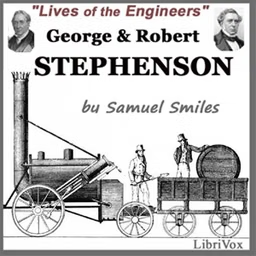
George Stephenson did not invent the steam engine, that was due to Newcomen and later to James Watt. He did not invent the steam locomotive, that was due to a number of people including Cugnot, Trevithick and others. He did not invent the Railway. Railways or tramways had been in use for two hundred years before Stephenson.
The reason why Stephenson was known as ‘The father of the steam locomotive’ was that he took a primitive, unreliable and wholly uneconomic device and turning it into an efficient machine not very different to those which ran until fifty or so years ago, married it with the iron rail and alone, and against considerable opposition,began, via the Stockton and Darlington Railway, the Liverpool and Manchester Railway and then the London and Birmingham Railway, the development of steam railways in England and the world.
George Stephenson began life in 1781 in the worst and poorest of all circumstances, he did not learn to read until he was twenty years old, but he, together with his son Robert, became the foremost engineers in the railway world.
If, in the middle years of the nineteenth century you wanted to build a railway, then, if you wanted it big bold and imaginative you might go to Mr. Brunel. If you wanted it to pay however, you would go to the Sephensons. (Summary by AJM)
The reason why Stephenson was known as ‘The father of the steam locomotive’ was that he took a primitive, unreliable and wholly uneconomic device and turning it into an efficient machine not very different to those which ran until fifty or so years ago, married it with the iron rail and alone, and against considerable opposition,began, via the Stockton and Darlington Railway, the Liverpool and Manchester Railway and then the London and Birmingham Railway, the development of steam railways in England and the world.
George Stephenson began life in 1781 in the worst and poorest of all circumstances, he did not learn to read until he was twenty years old, but he, together with his son Robert, became the foremost engineers in the railway world.
If, in the middle years of the nineteenth century you wanted to build a railway, then, if you wanted it big bold and imaginative you might go to Mr. Brunel. If you wanted it to pay however, you would go to the Sephensons. (Summary by AJM)
LibriVox recordings are public domain in the United States; copyright status may differ elsewhere.
Chapters
- Chapter 1
Introduction Part 1
27:17 - Chapter 2
Introduction Part 2
30:24 - Chapter 3
Chapter 1 Newcastle and the Great Northern Coal Field
19:25 - Chapter 4
Chapter 2 George Stephenson's Early Years
35:16 - Chapter 5
Chapter 3 Engineman at Willington Quay
29:46 - Chapter 6
Chapter 4 The Stephensons at Killingworth
27:24 - Chapter 7
Chapter 5 Early History of the Locomotive
49:00 - Chapter 8
Chapter 6 Invention of the 'Geordy' Safety Lamp
36:43 - Chapter 9
Chapter 7 George Stephenson's further Improvement of the Locomotive
28:18 - Chapter 10
Chapter 8 George Stephenson, Engineer of the Stockton and Darlington Railway
42:26 - Chapter 11
Chapter 9 The Liverpool and Manchester Railway Projected
53:54 - Chapter 12
Chapter 10 Chat Moss. Construction of the Railway
38:12 - Chapter 13
Chapter 11 Robert Stephenson in Colombia, The 'Rocket'
51:24 - Chapter 14
Chapter 12 Opening of the Liverpool and Manchester Railway
30:50 - Chapter 15
Chapter 13 Robert Stephenson Constructs the London and Birmingham Railway
29:33 - Chapter 16
Chapter 14 Manchester and Leeds and Midland Railways
39:42 - Chapter 17
Chapter 15 George Stephenson's Coal Mines
51:09 - Chapter 18
Chapter 16 Robert Stephenson's Career
36:22 - Chapter 19
Chapter 17 Robert Stephenson's Tubular Bridges at Menai and Conway
35:41 - Chapter 20
Chapter 18 George Stephenson's Closing Years - Illness and Death
29:23 - Chapter 21
Chapter 19 Robert Stephenson's Illness and Death. Stephenson Characteristics
47:06