Of all the mass of Japanese literature, which lies before us as the result of nearly twelve centuries of book-making, the most important monument is the work entitled Kojiki (古事記) or Records of Ancient Matters, which was completed in A.D. 712. It is the most important because it has preserved for us more faithfully than any other book the mythology, the manners, the language, and the traditional history of Ancient Japan.
E.M. Satow, in his paper on the "Revival of Pure Shintō," says:
"The Emperor Tenmu (天武天皇), at what portion of his reign is not mentioned, lamenting that the records possessed by the chief families contained many errors, resolved to take steps to preserve the true traditions from oblivion. He therefore had the records carefully examined, compared, and weeded of their faults. There happened to be in his household a person of marvellous memory named Hiyeda no Are (稗田阿礼), who could repeat without mistake the contents of any document he had ever seen, and never forgot anything that he had heard. Tenmu Tennō took the pains to instruct this person in the genuine traditions and 'old language of former ages,' and to make him repeat them until he had the whole by heart. 'Before the undertaking was completed,' which probably means before it could be committed to writing, the Emperor died, and for twenty-five years Are's memory was the sole depository of what afterwards received the title of Kojiki or Furukotobumi as it is read by Motoori (本居宣長). At the end of this interval the Empress Genmei (元明天皇) ordered Ō no Yasumaro (太安万侶) to write it down from the mouth of Are, which accounts for the completion of the manuscript in so short a time as four months and a half."
(From the Translator's Introduction)
One page and a few scattered sentences were translated by Basil Hall Chamberlain into Latin to preserve modesty.
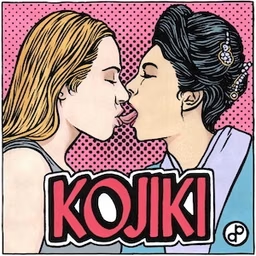
Cover: Communion of Sif and Uzume by cartoonist Robin Bougie (2024), released by him into the public domain.
Special thanks to Rino Iwashita, a student at Akita International University, for her help with Japanese pronunciation.
E.M. Satow, in his paper on the "Revival of Pure Shintō," says:
"The Emperor Tenmu (天武天皇), at what portion of his reign is not mentioned, lamenting that the records possessed by the chief families contained many errors, resolved to take steps to preserve the true traditions from oblivion. He therefore had the records carefully examined, compared, and weeded of their faults. There happened to be in his household a person of marvellous memory named Hiyeda no Are (稗田阿礼), who could repeat without mistake the contents of any document he had ever seen, and never forgot anything that he had heard. Tenmu Tennō took the pains to instruct this person in the genuine traditions and 'old language of former ages,' and to make him repeat them until he had the whole by heart. 'Before the undertaking was completed,' which probably means before it could be committed to writing, the Emperor died, and for twenty-five years Are's memory was the sole depository of what afterwards received the title of Kojiki or Furukotobumi as it is read by Motoori (本居宣長). At the end of this interval the Empress Genmei (元明天皇) ordered Ō no Yasumaro (太安万侶) to write it down from the mouth of Are, which accounts for the completion of the manuscript in so short a time as four months and a half."
(From the Translator's Introduction)
One page and a few scattered sentences were translated by Basil Hall Chamberlain into Latin to preserve modesty.
Cover: Communion of Sif and Uzume by cartoonist Robin Bougie (2024), released by him into the public domain.
Special thanks to Rino Iwashita, a student at Akita International University, for her help with Japanese pronunciation.
LibriVox recordings are public domain in the United States; copyright status may differ elsewhere.
Chapters
- Chapter 1
Preface
15:32 - Chapter 2
Vol 1 Sect 1-8
24:27 - Chapter 3
Vol 1 Sect 9-17
42:54 - Chapter 4
Vol 1 Sect 18-25
35:33 - Chapter 5
Vol 1 Sect 26-33
43:06 - Chapter 6
Vol 1 Sect 34-43
33:55 - Chapter 7
Vol 2 Sect 44-54
37:02 - Chapter 8
Vol 2 Sect 55-62
26:42 - Chapter 9
Vol 2 Sect 63-68
16:43 - Chapter 10
Vol 2 Sect 69-75
32:12 - Chapter 11
Vol 2 Sect 76-94
44:53 - Chapter 12
Vol 2 Sect 95-103
20:44 - Chapter 13
Vol 2 Sect 104-118
43:37 - Chapter 14
Vol 3 Sect 119-130
31:27 - Chapter 15
Vol 3 Sect 131-136
14:20 - Chapter 16
Vol 3 Sect 137-143
14:41 - Chapter 17
Vol 3 Sect 144-149
16:00 - Chapter 18
Vol 3 Sect 150-162
29:10 - Chapter 19
Vol 3 Sect 163-175
30:17 - Chapter 20
Vol 3 Sect 176-180
10:54