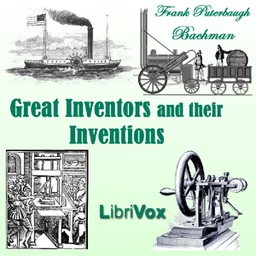
This book is about Great inventors and what they created. It has different stories like Alexander Bell, Wrights, Morse, Gutenberg, and Edison. ON August 17, 1807, a curious crowd of people in New York gathered at a boat landing. Tied to the dock was a strange-looking craft. A smokestack rose above the deck. From the sides of the boat, there stood out queer shaped paddle wheels. Of a sudden, the clouds of smoke from the smokestack grew larger, the paddle wheels turned, and the boat, to the astonishment of all, moved. It was "Fulton's Folly," the Clermont, on her first trip to Albany.
The first boat used by man was probably the trunk of a fallen tree, moved about by means of a broken branch or pole. Then some savage saw that a better boat could be made by tying a number of logs together to make a raft. But rafts are hard to move, so the heart of a log was hollowed out by means of a stone ax or fire, to make a still better boat, or strips of birch bark were skillfully fastened together to form a graceful canoe. Boats were constructed also of rough-hewn boards. With such primitive craft, voyages of hundreds of miles were made up and down great rivers like the Mississippi, or along the shores of inland seas like the Great Lakes.
The Phœnicians were the first great sailors. Their boats, called galleys, were sometimes two to three hundred feet long. These were of two kinds, merchantmen and war vessels. The merchantmen were propelled partly by sails and partly by oars, but on the war vessels, when in battle, oars only were used. On a single boat there were often several hundred oarsmen or galley slaves. These galley slaves were as a rule prisoners of war. They were chained to the oar benches, and to force them to row, they were often beaten within an inch of their lives. In enormous sail-and-oar vessels the Phœnicians crossed the Mediterranean in every direction, pushed out into the Atlantic Ocean, and went as far north as England.
The chief improvement in boat making, from the time of the Phœnicians until the first trip of the Clermont, was to do away with oars and to use sails only. - Summary by Elijah Fisher
The first boat used by man was probably the trunk of a fallen tree, moved about by means of a broken branch or pole. Then some savage saw that a better boat could be made by tying a number of logs together to make a raft. But rafts are hard to move, so the heart of a log was hollowed out by means of a stone ax or fire, to make a still better boat, or strips of birch bark were skillfully fastened together to form a graceful canoe. Boats were constructed also of rough-hewn boards. With such primitive craft, voyages of hundreds of miles were made up and down great rivers like the Mississippi, or along the shores of inland seas like the Great Lakes.
The Phœnicians were the first great sailors. Their boats, called galleys, were sometimes two to three hundred feet long. These were of two kinds, merchantmen and war vessels. The merchantmen were propelled partly by sails and partly by oars, but on the war vessels, when in battle, oars only were used. On a single boat there were often several hundred oarsmen or galley slaves. These galley slaves were as a rule prisoners of war. They were chained to the oar benches, and to force them to row, they were often beaten within an inch of their lives. In enormous sail-and-oar vessels the Phœnicians crossed the Mediterranean in every direction, pushed out into the Atlantic Ocean, and went as far north as England.
The chief improvement in boat making, from the time of the Phœnicians until the first trip of the Clermont, was to do away with oars and to use sails only. - Summary by Elijah Fisher
LibriVox recordings are public domain in the United States; copyright status may differ elsewhere.
Chapters
- Chapter 1
Preface
01:49 - Chapter 2
James Watt and the Invention of the Steam Engine
23:40 - Chapter 3
Robert Fulton and the Invention of the Steamboat
31:03 - Chapter 4
George Stephenson & Invention of the Locomotive
31:01 - Chapter 5
Invention of the Electric Engine
19:50 - Chapter 6
The Invention of the Spinning Machines
18:54 - Chapter 7
Eli Whitney & the Invention of the Cotton Gin
24:56 - Chapter 8
Elias Howe & the Invention of the Sewing Machine
26:15 - Chapter 9
Cyrus H. McCormick and the Invention of the Reaper
23:04 - Chapter 10
Henry Bessemer and the Making of Steel
38:45 - Chapter 11
John Gutenberg and the Invention of Printing
29:41 - Chapter 12
Samuel F. B Morse & the Invention of the Telegraph
31:41 - Chapter 13
Alexander Graham Bell & Invention of the Telephone
25:30 - Chapter 14
Thomas A. Edison
07:32 - Chapter 15
Orville and Wilbur Wright
09:13 - Chapter 16
Guglielmo Marconi
05:47 - Chapter 17
John P. Holland
08:05