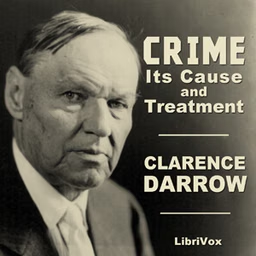
Clarence Darrow was an American lawyer. He remains notable for his wit and agnosticism, which marked him as one of the most famous American lawyers and civil libertarians.
In this book, Darrow expands on his lifelong contention that psychological, physical, and environmental influences—not a conscious choice between right and wrong—control human behavior. To my ears (the reader's), the author has a rather simplistic behaviourist view of human behaviour, but he argues his position with wonderful clarity. Darrow is coherently critical of conspiracy laws, of the creation of laws by the powerful (and consequently the definition of "crime" by that group) .... and his views on the machinery of "justice" and on how criminals are treated are still very relevant. (Summary adapted from Wikipedia.)
In this book, Darrow expands on his lifelong contention that psychological, physical, and environmental influences—not a conscious choice between right and wrong—control human behavior. To my ears (the reader's), the author has a rather simplistic behaviourist view of human behaviour, but he argues his position with wonderful clarity. Darrow is coherently critical of conspiracy laws, of the creation of laws by the powerful (and consequently the definition of "crime" by that group) .... and his views on the machinery of "justice" and on how criminals are treated are still very relevant. (Summary adapted from Wikipedia.)
LibriVox recordings are public domain in the United States; copyright status may differ elsewhere.
Chapters
- Chapter 1
Preface; Chapter 1: What is Crime?
21:16 - Chapter 2
Chapter 2: Purpose of Punishment
28:33 - Chapter 3
Chapter 3: Responsibility for Crime
14:16 - Chapter 4
Chapter 4: Environment
05:21 - Chapter 5
Chapter 5: Adjusting Heredity and Environment
04:46 - Chapter 6
Chapter 6: Psychology of Criminal Conduct
20:28 - Chapter 7
Chapter 7: The Criminal
22:48 - Chapter 8
Chapter 8: The Female Criminal
05:27 - Chapter 9
Chapter 9: Juvenile Criminals
09:19 - Chapter 10
Chapter 10: Homicide
11:11 - Chapter 11
Chapter 11: Sex Crimes
05:23 - Chapter 12
Chapter 12: Robbery and Burglary
02:23 - Chapter 13
Chapter 13: Man as a Predatory Animal
11:31 - Chapter 14
Chapter 14: Crimes against Property
11:44 - Chapter 15
Chapter 15: Attitude of the Criminal
11:55 - Chapter 16
Chapter 16: The Law and the Criminal
23:21 - Chapter 17
Chapter 17: Repealing Laws
06:33 - Chapter 18
Chapter 18: Is Crime Increasing?
14:22 - Chapter 19
Chapter 19: Medical Experts
11:04 - Chapter 20
Chapter 20: Punishment
12:59 - Chapter 21
Chapter 21: The Effect of Punishment on Others
05:26 - Chapter 22
Chapter 22: Evolution of Punishment
07:39 - Chapter 23
Chapter 23: Capital Punishment
10:19 - Chapter 24
Chapter 24: Stigmata of the Criminal
08:53 - Chapter 25
Chapter 25: The Good in Criminals
07:10 - Chapter 26
Chapter 26: The Defective and Insane
16:46 - Chapter 27
Chapter 27: Social Control
17:11 - Chapter 28
Chapter 28: Industrialism and Crime
17:17 - Chapter 29
Chapter 29: War and Crime
13:31 - Chapter 30
Chapter 30: Civilization and Crime
15:57 - Chapter 31
Chapter 31: The Convict
04:39 - Chapter 32
Chapter 32: Isolation and Sterilization
27:49 - Chapter 33
Chapter 33: Crime, Disease and Accident
07:22 - Chapter 34
Chapter 34: Luck and Chance
12:38 - Chapter 35
Chapter 35: Pardons and Paroles
15:55 - Chapter 36
Chapter 36: Remedies
21:22