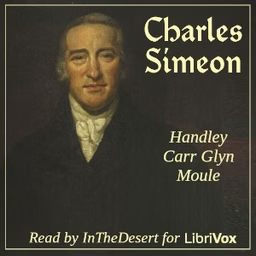
Charles Simeon had come up to King’s college from Eton, a wild undergraduate, famous for his love of horses and extravagance in dress; but one day he discovered that the rules of the college compelled him to receive the Communion on the following Sunday. He had lived in an utterly careless home, but he knew enough of religion to realise that attendance at the Lord’s Table was a serious thing, which should not be undertaken without some preparation. Not quite knowing what to do, he went to a bookseller’s shop, and bought a copy of Bishop Wilson on the Lord’s Supper, and learned from it for the first time the meaning of the Atonement. This was the turning point in his life. Henceforth all his energy was concentrated in a single channel. His one ambition was to make all Cambridge grasp this doctrine too.
He became Fellow of his college, and then took Holy Orders, and was appointed (1783) Minister of Trinity Church, in the Market Place. Here he learnt what it meant to be known as an Evangelical. The seat-holders deserted the church in a body, and locked the great doors of the pews, so that no one else should use them. When Simeon placed forms in the aisles, the churchwardens threw them out into the churchyard, and for more than ten years his congregation had to stand. Rowdy bands of under graduates used to try to break up the service. “For many years,” wrote one of his contemporaries, “Trinity Church and the streets leading to it were the scenes of the most disgraceful tumults. In vain did Simeon exert himself to preserve order. In vain did Parish, who was popular with the under graduates, station himself outside the door to prevent improper conduct; though one undergraduate, who had been apprehended by Simeon, was compelled to read a public apology, the disturbances still continued.” “Those who worshipped at Trinity,” wrote another, “were supposed to have left common sense, discretion, sobriety, attachment to the Established Church, love of the liturgy, and whatever else is true and of good report, in the vestibule.”
But Simeon went on with his work with quiet pertinacity, never deliberately doing anything to provoke opposition, but never flinching from declaring what he knew to be the truth, and won first toleration, and then recognition as the most inspiring teacher in Cambridge. Trinity Church was always crowded with undergraduates. His Friday Conversation Circle for the discussion of religious questions, his Bible Class and Doctrine Class never failed to fill his room at King’s with eager young disciples, and especially his famous Sermon Class, in which most of the Evangelical preachers of the next generation were trained. And this continued for fifty years with results which no man can estimate. A teacher so wise, so genial, so spiritual, moulding the lives of the men from whom the bulk of the clergy were drawn, acquired a position almost unique in the English Church. “If you knew what his authority and influence were,” wrote Lord Macaulay, who was himself at Cambridge in Simeon’s later days, “and how they extended from Cambridge to the most remote corners of England, you would allow that his real sway in the Church was far greater than that of any Primate.” Down to comparatively modern times in undergraduate slang an earnest Christian was always called a “Sim”.
- Summary from "A History of the Evangelical Party in the Church of England" by GR Balleine
He became Fellow of his college, and then took Holy Orders, and was appointed (1783) Minister of Trinity Church, in the Market Place. Here he learnt what it meant to be known as an Evangelical. The seat-holders deserted the church in a body, and locked the great doors of the pews, so that no one else should use them. When Simeon placed forms in the aisles, the churchwardens threw them out into the churchyard, and for more than ten years his congregation had to stand. Rowdy bands of under graduates used to try to break up the service. “For many years,” wrote one of his contemporaries, “Trinity Church and the streets leading to it were the scenes of the most disgraceful tumults. In vain did Simeon exert himself to preserve order. In vain did Parish, who was popular with the under graduates, station himself outside the door to prevent improper conduct; though one undergraduate, who had been apprehended by Simeon, was compelled to read a public apology, the disturbances still continued.” “Those who worshipped at Trinity,” wrote another, “were supposed to have left common sense, discretion, sobriety, attachment to the Established Church, love of the liturgy, and whatever else is true and of good report, in the vestibule.”
But Simeon went on with his work with quiet pertinacity, never deliberately doing anything to provoke opposition, but never flinching from declaring what he knew to be the truth, and won first toleration, and then recognition as the most inspiring teacher in Cambridge. Trinity Church was always crowded with undergraduates. His Friday Conversation Circle for the discussion of religious questions, his Bible Class and Doctrine Class never failed to fill his room at King’s with eager young disciples, and especially his famous Sermon Class, in which most of the Evangelical preachers of the next generation were trained. And this continued for fifty years with results which no man can estimate. A teacher so wise, so genial, so spiritual, moulding the lives of the men from whom the bulk of the clergy were drawn, acquired a position almost unique in the English Church. “If you knew what his authority and influence were,” wrote Lord Macaulay, who was himself at Cambridge in Simeon’s later days, “and how they extended from Cambridge to the most remote corners of England, you would allow that his real sway in the Church was far greater than that of any Primate.” Down to comparatively modern times in undergraduate slang an earnest Christian was always called a “Sim”.
- Summary from "A History of the Evangelical Party in the Church of England" by GR Balleine
LibriVox recordings are public domain in the United States; copyright status may differ elsewhere.
Chapters
- Chapter 1
Family and School
19:12 - Chapter 2
Cambridge - Conversion
18:34 - Chapter 3
Trinity Church
25:26 - Chapter 4
The Parish
31:22 - Chapter 5
The University
26:59 - Chapter 6
Growing Influence
24:52 - Chapter 7
Preacher, Theologian, Churchman
34:10 - Chapter 8
India - Religious Societies
30:33 - Chapter 9
Henry Martyn and Other Friends
35:37 - Chapter 10
Scotland
27:22 - Chapter 11
Work in Weakness
22:53 - Chapter 12
Letters
25:48 - Chapter 13
Correspondents
19:54 - Chapter 14
Conversation Circles
36:22 - Chapter 15
Closing Years
30:24 - Chapter 16
The Last Months
16:36 - Chapter 17
Death and Burial
22:35