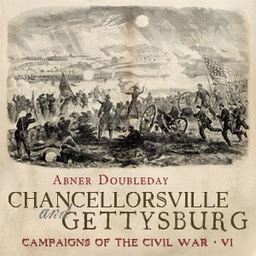
Abner Doubleday began the Civil War as a Union officer and aimed the first cannon shot in response to the bombardment opened on Ft. Sumter in 1861. Two years later, after a series of battles (including Antietam, where he was wounded), Doubleday took over a division in the Army of the Potomac's 1st Corps.
These are his memoirs of service in two of the War's great campaigns. At Chancellorsville, a very promising start made by General Hooker against Lee's Confederate forces fell to a defeat when, in Doubleday's estimation, normal and prudent precautions against surprise in the heavily-wooded battlefield were not carried out; he also seemingly apologizes for Hooker's lack of leadership during the battle as a result of his having been stunned by a cannon ball hitting the post against which he was leaning.
After Chancellorsville, Hooker was replaced as Army Commander by General George Meade. Doubleday describes the curious circumstances that led the two opposing armies to meet at Gettysburg in Pennsylvania. When Doubleday's superior, General John Reynolds, was killed by a sharpshooter on the first day's battle, he took over the 1st Corps and fought it well against converging Confederate divisions that badly outnumbered him. The Corps was forced by battle losses to retire, but its desperate fight bought the time needed for Union reinforcements to pour into Gettysburg and thus prevent a defeat in detail.
General Howard of the XIth Corps replaced Doubleday as the senior commander on the field, and mistakenly wrote to Meade that 1st Corps had routed after practically no fighting. Thus, when Meade arrived, he removed Doubleday from command of 1st Corps, replacing him with a more junior general from another Corps. The snub would embitter Doubleday against Meade. This book is in part Doubleday's revenge, as he picks apart Meade's indecision after the battle was essentially won, with the repulse of the famous Pickett's Charge. In his view, Meade could have won the war at that moment. (Summary by Mark Smith)
These are his memoirs of service in two of the War's great campaigns. At Chancellorsville, a very promising start made by General Hooker against Lee's Confederate forces fell to a defeat when, in Doubleday's estimation, normal and prudent precautions against surprise in the heavily-wooded battlefield were not carried out; he also seemingly apologizes for Hooker's lack of leadership during the battle as a result of his having been stunned by a cannon ball hitting the post against which he was leaning.
After Chancellorsville, Hooker was replaced as Army Commander by General George Meade. Doubleday describes the curious circumstances that led the two opposing armies to meet at Gettysburg in Pennsylvania. When Doubleday's superior, General John Reynolds, was killed by a sharpshooter on the first day's battle, he took over the 1st Corps and fought it well against converging Confederate divisions that badly outnumbered him. The Corps was forced by battle losses to retire, but its desperate fight bought the time needed for Union reinforcements to pour into Gettysburg and thus prevent a defeat in detail.
General Howard of the XIth Corps replaced Doubleday as the senior commander on the field, and mistakenly wrote to Meade that 1st Corps had routed after practically no fighting. Thus, when Meade arrived, he removed Doubleday from command of 1st Corps, replacing him with a more junior general from another Corps. The snub would embitter Doubleday against Meade. This book is in part Doubleday's revenge, as he picks apart Meade's indecision after the battle was essentially won, with the repulse of the famous Pickett's Charge. In his view, Meade could have won the war at that moment. (Summary by Mark Smith)
LibriVox recordings are public domain in the United States; copyright status may differ elsewhere.
Chapters
- Chapter 1
00 - Preface
04:39 - Chapter 2
1-01 - The Opening of 1863 - Hooker's Plans
18:50 - Chapter 3
1-02 - Friday, The First of May
15:03 - Chapter 4
1-03 - The Disastrous Second of May
09:56 - Chapter 5
1-04 - The Rout of the Eleventh Corps
20:27 - Chapter 6
1-05 - Jackson's Advance Is Checked
11:43 - Chapter 7
1-06 - Sickles Fights His Way Back; Arrival of the First Corps
08:00 - Chapter 8
1-07 - The Battle of the Third of May
35:37 - Chapter 9
1-08 - May 4th: Attack on Sedgwick's Force
25:17 - Chapter 10
1-09 - Preparations to Renew the Conflict
11:19 - Chapter 11
1-10 - Battle of Brandy Station: Fleetwood
06:58 - Chapter 12
2-1 - The Invasion of the North
20:58 - Chapter 13
2-2 - Hooker\'s Plans. Hooker Superceded by Meade
35:49 - Chapter 14
2-3 - Stuart\'s Raid
13:02 - Chapter 15
2-4a - The First Day at Gettysburg, Part A
30:14 - Chapter 16
2-4b - The First Day at Gettysburg, Part B
32:25 - Chapter 17
2-5a - Battle of Gettysburg - The Second Day, Section 1
26:45 - Chapter 18
2-5b - Battle of Gettysburg - The Second Day, Section 2
30:23 - Chapter 19
2-6 - The Battle of the Third Day
34:34 - Chapter 20
2-7 - General Retreat of the Enemy
14:29